
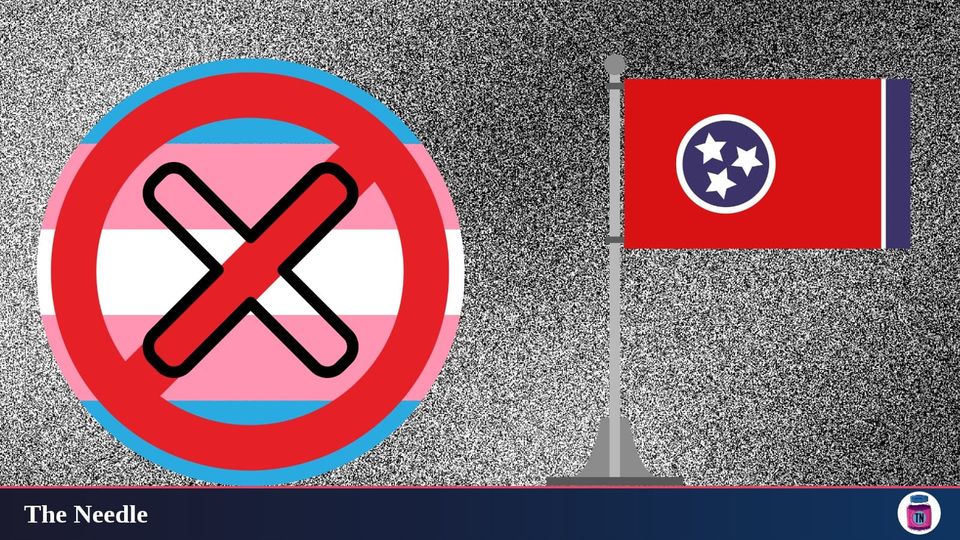
The Tennessee legislature has passed a series of bills that comprise the most aggressive anti-trans regime in the US to date.
The last week has seen a flurry of anti-trans legislative motions in Tennessee.
All seven are likely to become law. At the time of publication, one has been signed, two others are sitting on the Governor’s desk, and the remaining four have been approved in some form but require further legislative action before they can be signed. If approved, some of the laws will go into effect immediately, while others would take effect on July 1.
The individual bills are:
- HB 2499 | SB 2118: A total ban on transition medicine coverage through the state Medicaid program, TennCare, has been signed into law.
- HB1476 | SB 1741: The “Charlie Kirk Act,” which emboldens hate-based harassment on college campuses, awaits Gov. Lee’s signature.
- HB 2082 | SB 1989: A bill that says that parents and guardians who reject the identity of a trans child in their care cannot be considered child abusers awaits Lee’s signature.
- HB 1666 | SB 1665: A bill that prohibits instructing people to use specific honorifics for teachers, educators, and state employees/contractors has been approved in some form by both chambers, and awaits further legislature action.
- HB 1271 | SB 0936: A bill declaring (falsely) that human sex is rigidly binary and immutable, erasing trans and intersex people alike, has been approved in some form by both chambers and awaits further legislature action.
- HB 0754 | SB0676: A bill that creates a publicly-downloadable database of people receiving transition care (not including names, but including age and sex, medications and surgical interventions prescribed, and names and contact information of prescribing doctors) has passed both chambers, and awaits House Speaker signature before being transmitted to the governor.
- HB 0571 | SB 0468: The “Riley Gaines Women’s Safety and Protection Act,” which defines “sex” as based on one’s visible genitalia at birth and mandates trans-exclusive gender/sex segregation across public and private accommodations in many contexts, has passed both chambers and awaits further legislature action before being transmitted to the governor.
Editor's Note: TennCare had already administratively excluded transition coverage as recently as its August 2024 revision to its coverage standards. Thank you to Aleksandra Vaca of Transitics for providing a source for this update.
It appears that the backers of these anti-trans laws have dodged greater grassroots pressure and media coverage by passing a series of bills instead of a single omnibus.
As the Tennessee Legislature has closed their session for the year, it is unclear if bills, including some of the above, that were approved by both chambers but not yet sent to the Governor's desk will be sent off to the Governor's desk.
Join The Needle's mailing list:
Author’s Note: Coverage and further discussion of three of these bills is below. Jane also did a weekslong investigation into HB 0754 | SB 0676, which will be published separately.
The TennCare (Medicaid) Denies Your Needed Medicine Bill
This law, signed by Gov. Bill Lee on April 16, bans the state Medicaid program from covering transition healthcare.
According to USA Today’s prior coverage,
“Sen. Adam Lowe, R-Calhoun, who sponsored the bill, said his goal is making sure TennCare “stays focused on real health care needs.”
“We want to protect patients while also being good stewards of taxpayer dollars, ensuring funds are used for treatments that are clearly tied to health and wellness,” Lowe said.”
Of course, transition medicine is “clearly tied to health and wellness” under any honest or objective metric, as it clearly improves the health and well-being of recipients. That’s arguably the problem. Further, hormones and other medications used in trans care are used in far larger numbers by cisgender people–without legislative interference.
Studies have repeatedly shown that the regret rates for transition medicine is steady between 1%-2%, whereas patients who have procedures such as cardiac surgery or knee surgery are far more likely to report regretting it later.
According to official Tennessee government statistics, roughly 1.4 million people in the state are covered by TennCare, or about one in five people living in the state..
As trans people are disproportionately likely to be impoverished or in financially precarious circumstances–according to multiple studies, such as a report from the Human Rights Campaign that found that trans women have the steepest wage gap of any minority group—it’s reasonable to assume that a substantial number of trans people in Tennessee use TennCare, which will be unable to cover their healthcare.
Tennessee: The “Charlie Kirk Act”
This bill, which passed with a veto-proof supermajority, enables anyone in Tennessee (or anyone who paid taxes in Tennessee) to wage lawfare via legal attrition against public institutions of higher education in the state. This is on top of chilling any public education institution’s ability to un-invite speakers based on student feedback or other issues that may be uncovered about a speaker after the opportunity is presented to them, as well as ensuring that employers that recruit on campuses and student groups alike have the right to hateful speech that discriminates or is unfair, unkind, harassing, or otherwise against trans people, queer people, and/or bodily autonomy.
The bill requires all public colleges and universities in Tennessee to:
(1) Adopt a statement on freedom of expression that is identical or substantially similar to the University of Chicago's Freedom of Expression Policy and formally incorporate that statement into the institution's bylaws and post that statement on the institution's website; and
(2) Adopt a statement on the institution's role in political and social action that is identical or substantially similar to the Report on the University's Role in Political and Social Action (Kalven Report) issued by the University of Chicago in 1967 and formally incorporate the statement into the institution's bylaws and post the statement on the institution's website.
As for that report’s history, it had been an obscure report for decades and has only in recent years been made into a cudgel for those who advocate for their version of what they call “campus neutrality”.
According to reporting by Forbes from 2023, there’s a lot more context and nuance involved with the Kalven report overall:
Arguing that the University had applied the Kalven Report more rigidly than its framers might have intended, Jamie Kavlen added,“My father’s position was that the First Amendment is almost an absolute, but everything hinges on that ‘almost.’ We have to be prepared to have that argument again and again in those types of situations, and that’s a good thing. If it’s an absolute, people just sort of apply it reflexively, thoughtlessly, and don’t really grapple generation to generation with the nature of the principle.”
Other scholars have come to similar conclusions, leading them to caution against universities automatically relying on the Kalven Report to defend their silence on controversial matters. In addition to the philosophical question of whether a position of total neutrality is even possible, here are three other issues worth considering.
The Premise Of The Kalven Report Report Is Faulty
Robert Post, Sterling Professor of Law at Yale Law University, has recently criticized the Kalven Report for jumping to the conclusion that a university cannot express an institutional position on controversial issues without endangering its faculty’s academic freedom.
Post argues that it’s “a mistake to equate institutional neutrality with academic freedom” because the “relationship between institutional neutrality and academic freedom is empirical and contingent.” Some violations of institutional neutrality might infringe on faculty’s academic freedom, while others would likely have no effect whatsoever. It’s not a matter of logic or of inevitability, but of specific factual events.
While the entire history of the Kalven report is interesting, what is relevant here is how the legislature uses it as part of an overall push to mandate a false sense of neutrality on college campuses.
That very weaponization of the Kalven report was warned against by those who are familiar with it.
This is illuminated when you couple the provisions of the bill above with the rest of the bill, which follows:
This bill prohibits public institutions of higher education and faculty members of such institutions from doing the following:
(1) Refusing to invite a speaker because of the viewpoints expressed or espoused by the speaker or canceling an invitation of the speaker to speak at the institution in response to threatened protests or opposition from students or faculty;
(2) Prohibiting a student organization from inviting a speaker to campus or restricting a student organization in its choice of invited speakers;
(3) Retaliating against a faculty member on account of the viewpoints expressed in the faculty member's scholarly work, or on account of any speech or writing protected by the First Amendment of the United States Constitution;
(4) Discriminating or retaliating against a person on account of the person's sincere religious beliefs;
(5) Discriminating or retaliating against a person on account of the person's opposition to abortion, homosexuality, or transgender behavior, regardless of whether that opposition is motivated by religious or non-religious beliefs; and
(6) Denying recognition to any student group, or denying any employer access to on-campus student interviews, on account of the student group's or employer's beliefs or opposition as described in (4) and (5).
This bill authorizes any resident, citizen, or taxpayer of Tennessee to petition for writ of mandamus or injunction against a public institution of higher education that violates or fails to ensure compliance with the requirements of this bill, or against the president or provost of any such institution. This bill requires a court to issue a writ of mandamus or injunction if the court finds that the institution has violated or failed to ensure compliance with the requirements of this bill. This bill waives sovereign and official immunity in any action for a writ of mandamus or injunction brought pursuant to this bill.
This bill authorizes various persons and groups to bring suit against a higher education institution's faculty member or agent for infringement of the person's or group's rights based on a violation of this bill's prohibitions. The full text of this bill specifies four types of relief that may be sought, procedural requirements, 13 prohibited defenses, and two affirmative defenses that apply to suits brought pursuant to this bill.
In other words, it does what it’s named for: it enshrines Charlie Kirk’s legacy of hate speech masquerading as free speech and college “debate” as mandatory aspects of college life and higher education institutions across the state.
The Parents Rights’ (To Abuse Their Trans Kid) Bill
This bill is a permission slip for abuse against trans kids in the state in that it declares that rejecting a trans child’s gender identity, including denying them transition-related healthcare (or forcing them to get care that is inconsistent with their gender identity), cannot be treated as child neglect, abuse, or endangerment, and cannot be the basis for removing a child from a home or a factor in custody disputes.
According to a Tennessee House GOP press release, this bill is framed by Republicans as:
"The legislation comes as Democrat-led states like California and Minnesota have advanced policies to penalize parents who don’t affirm their child’s transgender ideology. House Bill 2082 will take effect immediately upon the governor’s signature."
What this means is that, once again, the Republicans are enabling child abuse and using the powers of the state to hurt children—in this case, in an acute application of spite because Democrats in two states took steps to protect them.
The Anti-Trans Regime in Tennessee
Combined, the bills would or do make it illegal to:
- refer to a person by the correct title;
- house a person in anything other than solitary confinement across prisons, schools, and shelters from abuse;
- cover necessary medical care for a person under the state’s insurer-of-last-resort (Medicaid);
- acknowledge that people might exist outside of the pseudoscientific notion that human sex is fully binary and immutable;
- Provide the medical privacy to a person that everyone else receives per federal law;
- acknowledge that hate speech and harassment on colleges are harmful behaviors that should be curtailed;
- protect a child from parental abuse–
if the person in question (whether child or adult) happens to be trans, making it so that Tennessee has the most aggressive anti-trans regime at the state level to date.
Multiple other states in the US have some of these components, however these changes combined with the existing state of anti-trans law and policy in the state of Tennessee combine into the harshest anti-trans regime currently in the United States.