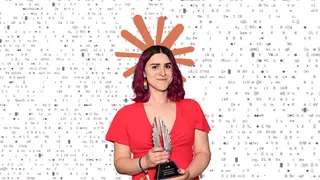

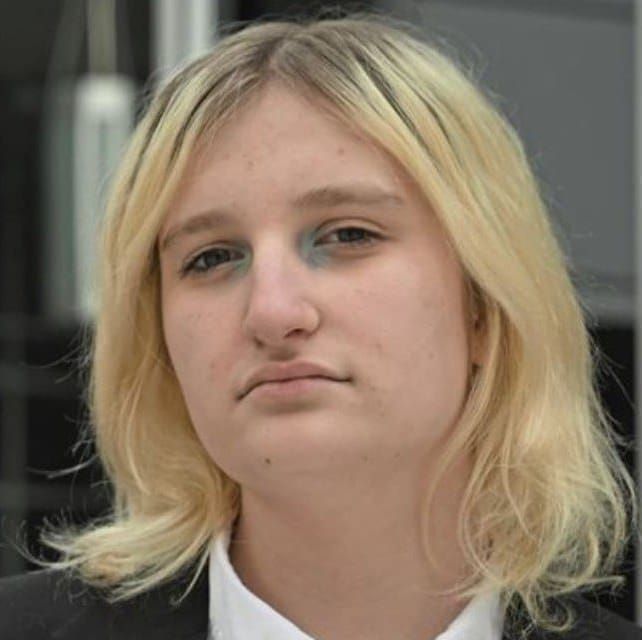
On a weekday morning, when most teenagers are at school, Sea Sombar is hard at work planning her debut documentary, Transcribe.
Trans kids like her are expected to do a lot for themselves. They have to understand themselves, advocate for themselves, and learn to live in a world that is increasingly hostile to them.
Sea Sombar has lived all this, and wants to do more. In what would have been her senior year of high school, she has dropped out, is going on the road, and making a documentary about the lives of trans kids like her.
Her motivation was simple. “I need to show people what it's like to be a trans person in the United States today.”
But whereas most people would be content to simply post about them, Sea Sombar wanted to do something greater. As a fellow trans kid, she knew full well what they were going through. As a filmmaker and documentarian, she had the skillset to show this to others.
So she set off to do just that. Upon turning 18, she dropped out of high school, put her life on hold, and set off across America, filming a documentary about being a trans kid today.
Join The Needle's mailing list:
Growing Up
Sea has always been used to this kind of work. She came out at age 13 in 2020, just before the campaign villainizing trans people kicked into full gear.
While her family was supportive, her school was not. She recalled how “eighth grade was quite difficult” due to “being in a suburban town where people think that they understand transness, but they don't”. This led to “instances with students,... with teachers constantly dead naming me, mispronouning me. And even when I went to the principal and higher up administration, nothing was done.”
Rather than take this lying down, she transferred to the Performing Arts School Pittsburgh CAPA, which she sung the praises of. “All of high school, I went to a performing arts high school in the city of Pittsburgh, which was way better. No bullying, nothing like that. All the teachers were great”, she said.
It was here where she felt she “was coming into a world that was a lot safer for trans young people.” She said was able “to just live [her] life normally, not thinking about young people in other states and their situations.”
In a school dedicated to the arts, her love of filmmaking began to grow. During her high school years, she made a number of short films, with one, Nail Polish, winning awards both locally and internationally. She explained how “that whole film is just about the trans experience. It was for trans youth by trans youth.”
This area of focus, her ability to tell stories, as well as the ability to draw upon her personal experiences, became vital when the federal government came for her healthcare. Like countless other kids, her HRT provider was threatened after the new administration declared that kids like her shouldn’t have it.
In June 2025, she lost access to that HRT when UPMC (which had been the main provider for trans youth in the Pittsburgh area) shut down access on the administration’s orders. She was told to taper off her medication with no consideration for her health, along with nearly 400 other kids.
She has since regained access through a source we cannot disclose.
This and other shutdowns prompted Pa. Gov. Josh Shapiro to host a roundtable of trans kids affected by the closures. Sea was one of the only people from Western Pennsylvania to be invited.
“Meeting Shapiro definitely [did] leave an impact on me… We all were able to share our stories and after we were done speaking with the governor we had time to talk with each other. They all were trying to give me advice on my HRT access etc. Most of them were from Philadelphia so they all had a different perspective from me. So it was great hearing their stories, some had supportive parents and some didn’t.”
It was around this time that she realized her experiences as a trans kid and her skill for storytelling could be combined into something greater. This is how the plans for the documentary began to be formed.
“I need to show people what it's like to be a trans person in the United States today”, she told me.
One small problem: she was still in high school. In Pennsylvania where she lives, students have to stay in education until the age of 18. However, once they turn 18, they are free to leave.
So that’s what she did. Once she could, she dropped out of school to work on the documentary full time. She plans to get her GED later in the year, but for now, she has her hands full.
Transcribe
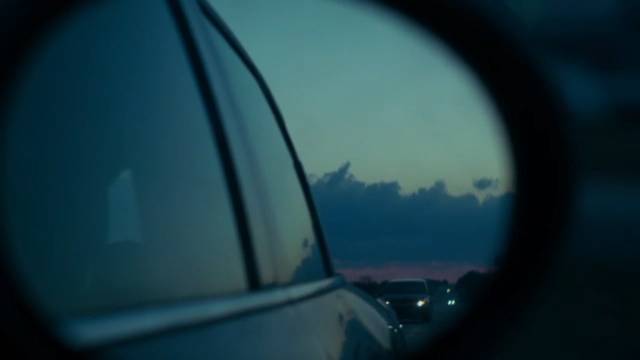
Her upcoming documentary is called Transcribe. Her goal is to get a picture of trans youth life in the current moment. The plan is simple: travel to every state in the union, interview trans kids along the way, and tell their stories.
So far, she has only done the first leg of this trip. Visiting the Midwest, she has seen how conditions have deteriorated rapidly in the last five years. Almost every midwestern state has cut off access to trans youth care, and the ripple effects of this are vast.
Sea told the story of Ellison, an 18 year-old from Texas who “grew up in Texas [but] ended up having to move to Illinois.” This was no easy decision, as he was forced to choose between his family network and his dignity as a trans man. Sea recalled how “his whole family was in Texas. He grew up in Texas. He is Texan. That is his life, and that is his story. And it was devastating to have to move to a different state.”
This was the norm across the Midwest. While most of the region is actively hostile to trans existence, Illinois and Minnesota stand as magnets pulling in those who are being pushed out. For the young, they stand as oases of dignity, safety, and healthcare access in what is otherwise an unforgiving desert.
This dynamic played out in many of the people Sea interviewed. Everyone she interviewed at least seriously considered the idea of moving, even if they couldn't manage it for whatever reason. And for those who can’t move, they often need to take long journeys to get ahold of HRT.
“There was a young trans girl named Flower that I interviewed in Indiana… Since there's no health care access within Indiana and a lot of the Midwest, they drive to other states to get health care. And that's very expensive and takes a lot of time”, she said.
When healthcare might only be found a day’s car ride away, and where kids don’t have the means to travel those distances, most people won’t have that healthcare.
“The youth that I interviewed within the Midwest, almost none of them were actually on hormones or gender affirming care, because either their parents were sort of supported but not fully, or they did not have access to drive to a different state to access health care. There are also other youth that were on healthcare for a time, but had to stop because of the state's ban in recent years”, she recalled.
This restriction also extended to feelings of safety, particularly in public. “Everyone I asked a question about bathrooms was scared of bathrooms. [It] caused them distress or pain because they chose to not go to the bathroom, either in public or at school. They were told that they were not allowed to use the bathroom of their preferred gender”, she said.
The fear of bathrooms by trans people is so prominent that while traveling, Sea had to change her behavior based on what state she was in. “I choose to use the girls bathroom, and I feel safe doing that here in Pittsburgh. Sometimes it was a little bit scary on the road”, she recalled.
In this environment, when leaving your front door means putting your guard up, Sea wanted to interview her subjects where they were most comfortable. Almost without exception, this was in their bedrooms. Even as these kids are suffering hardships at the hands of the outside world, they are still kids, and this shapes how she talks to her fellow kids.
“I'm talking about; What are your hobbies? How do you like to spend your time? Are you in a relationship? What are your friendships like? What's your family like?” It’s these basic but ultimately humanizing questions that she focuses her interviews around.
This is a level that Sea, as an 18 year-old, is able to capture, but which many older documentarians would be unable to do. “When I go into interviews, I'm trying to be their bestie. I'm just trying to gossip with them. I think as another young person, I'm able to just have fun with it”, she said, her tone of voice noticeably brightening.
This approach of humanizing kids who most people only ever see through a screen is also why she insists on traveling to all 50 states, even with the difficulties involved. “It's very important that I go to every state, because I think I could do an online interview with them, and I could record like the Zoom call or whatever, but I think there's something very personal about [the fact that] I'm in your bedroom and I'm able to look at like where you're living. I'm able to capture that.”
So far, the approach seems to be working. Almost every person she spoke to is still in touch.
This becomes important as many of these Midwestern kids are forced to move in search of healthcare, dignity, and safety. Even in the few months since this trip, her interviewees have made such moves.
For example, Ellison, the boy who moved from Texas to Illinois, is not alone. More people will move over time, and Sea wants to capture this migration. This will be a central part of the story, though this has not yet been filmed.
For now, she is planning the next legs of her journey. In the coming months, she will visit the South and the Northeast, working to make good on that 50 state promise.
How To Help
Transcribe is still in the early stages of being filmed. Most of what Sea plans to film hasn't been filmed yet. That means you can still help.
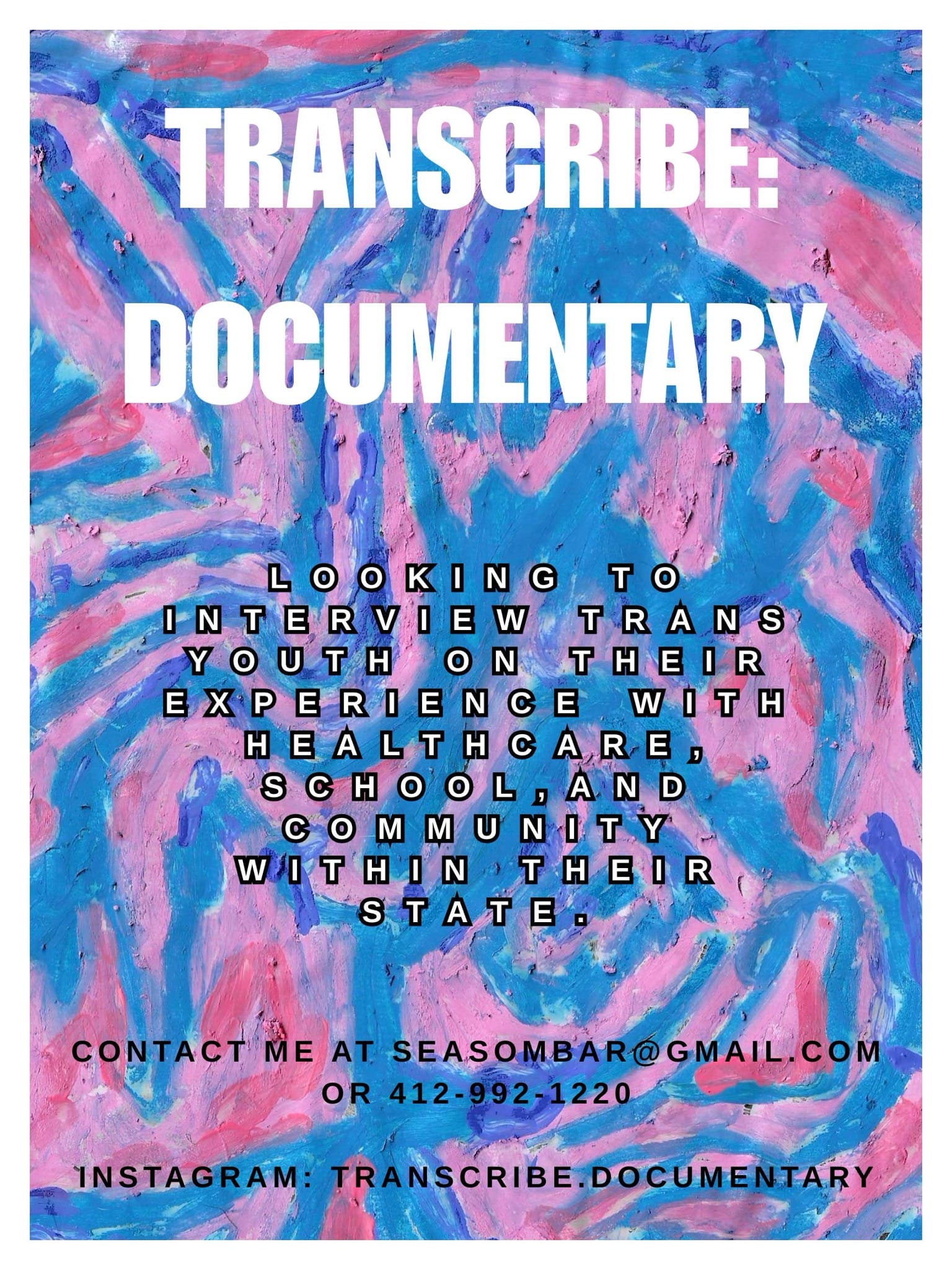
She is still looking for a large number of people to interview. That might mean you! She wants trans youth 21 and under, covering subjects of healthcare, school, and community, state-by-state.
To get involved, you can reach out to her at: seasombar@gmail.com or +1 (412) 992-1220.
You can find more info at @transcribe.documentary on Instagram.
If you want to support the project in other ways, you can donate to it HERE.