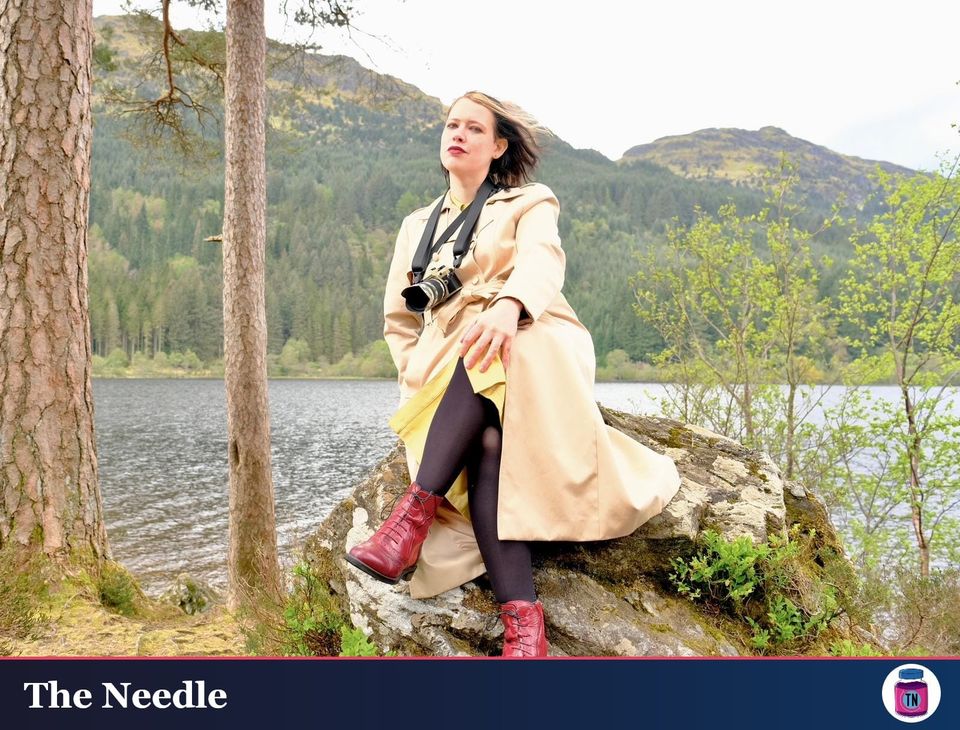
James Bond is dead… for now. Podcaster November Kelly of “Kill James Bond” is just getting started.
By Marley Jay
When she’s recording, November Kelly aims her pale blue eyes at the floor in front of her, listening, the thin blonde streak at the front of her dark hair dangling down, until an idea sparks. Then she’ll look up, lean into her mic, and bust up the room with a joke like, “A lubed customer is a happy customer.”
Kelly, who lives in Glasgow and turned 35 on May 7, has a posh, sonorous voice and a way with absurdist quips and mordant one-liners, often directed at herself. Her pitch varies as she continues to voice train; the fancy a bourbon, darling? smoothness does not. She possesses deep knowledge of philosophy, literature, history, law, and film, and a remarkable skill for keeping conversations moving even when she’s sharing a mic with three other hosts and a guest, all showing off how funny they are. In the midst of all that, she’ll often land the best jokes.
“She’s the beating heart of the entire British leftwing podcast ecosystem,” says her ‘Kill James Bond’ co-host and editor Devon. [Devon prefers to go by one name, citing their activist work and the possibility they’ll one day resume their teaching career.] “She always blows me away with the depth and breadth of her knowledge. She’s got this beautifully sharp analytical mind.”
Kelly co-hosts five comedy podcasts, four of which she co-created, and three that she leads as showrunner. These brainy, silly, Leftist, queer and trans-led shows have more than 40,000 paid monthly Patreon subscribers in total, and according to Kelly and her co-hosts, they amass about one million combined downloads and YouTube views per month. She’s found unexpected success in the medium, periodically sells out live events with her co-hosts, and is using her reach to lift queer and trans voices when governments and many of the world’s powerful people are working to silence them.
“I’m trying to suggest the possibility of a transgender life that is politically active and engaged, and that is unashamedly intellectual,” Kelly said in an online interview.
There’s a yogurt ad near the heart of this. You’ll see.
Kelly spends 10 to 12 hours a week recording her podcasts, and in any given week, she and her colleagues will talk about current events and tech (Trashfuture), movies from Bicycle Thieves to The Fast and the Furious with a queer and trans bent (Kill James Bond), engineering disasters like train crashes and bridge collapses (Well There’s Your Problem), the way mayors go mad with just a little power (No Gods No Mayors), and the transgendery-ness of detectives in fiction (Be Gay Solve Crimes).
To prepare, she keeps up with the news, researches the historical events and figures she’ll discuss, watches every film she’ll talk about, preferably at least twice, pausing to take notes and jokes, and to record bits of amusing audio to use as ‘drops’ on the podcasts, and sketches out upcoming episodes over long phone calls and text chains with the other hosts. According to her former spouse, fantasy writer Christopher Caldwell, she sometimes works 60 hours a week.
“In a just society she'd be presenting radio and panel shows on the BBC,” her Kill James Bond co-host Abigail Thorn said in an email. “She absolutely has the chops to present media at the highest level and the fact our country is too short-sighted to offer her those kinds of jobs is a tragedy for the entire industry.”
Listening to Kelly or watching her in live shows, where she pulls off the same act in front of an audience, letting her collaborators get laughs and building on their tangents, dropping off-the-cuff references to everything from Assassin’s Creed to Shakespeare, it’s easy to see Thorn’s point.
However, in interviews with Kelly and those closest to her, a different goal emerges. In a world that’s trying to atomize everyone into total loneliness, she’s trying to connect people. Even as humans are encouraged to sand off their rough edges and talk and think like brands, and as they’re drowned in AI slop that pushes them toward a hyper-homogenized middle, Kelly argues that using your brain—specifically the broken things only your singularly traumatized brain won’t stop doing—are the only things worth doing. As the powerful try to make queer and trans people retreat to the shadows, she says the way to stay alive is to get smarter and weirder.
“I’m trans in part because I believe in the hope of a better future. It’s why I do this. It’s why I do anything,” she says.
1. Be Gay
Of all her podcasts, Kill James Bond might cut closest to Kelly’s core. As a teen, she fell in love with French and German New Wave films, becoming a bona fide fanatic during a film studies course in university. Her wife Gwen says that they’ll often relax at home by watching four or five movies in a night—not including the movies Kelly needs to watch for work. [Gwen preferred not to give her last name, citing potential career concerns.]
There is the deeply trans origin of the show itself. Kelly, Devon and Thorn connected through Twitter and through appearances on Trashfuture, and built a friendship in a lockdown-era D&D game. In late 2020, Thorn told others she was transgender. She says she didn’t have any trans people in her life at the time, and didn’t know where to turn for help. (Thorn’s YouTube channel, PhilosophyTube, had almost a million subscribers then, and Devon recalls that people in online trans spaces were already speculating about her gender.)
“I had come out to myself and got through the first few months alone,” Thorn wrote. “I told her I felt like being in the closet was like going to war every day, and I'll never forget what she said in reply: ‘Lol. Well, being trans is a different kind of war, but it's one worth fighting.’"
Kelly and Devon advised Thorn on day to day concerns, like makeup and clothes, and also on how to come out publicly. During this time, Kelly tweeted out the idea of a Bond-themed podcast. She was surprised when Thorn said she was in. They’d both grown up watching Bond movies with their dads, and were experienced in the militarized, hyper-masculine environment of private school and the Combined Cadet Force, a government-sponsored youth organization for people with an interest in military service.
Thorn announced her transition in January 2021, and Kelly and Devon helped her update her social media accounts as the news broke. They dropped the first episode of Kill James Bond three weeks later. The three still had never been in the same room at the same time.
On the surface, the show sounds like a Woke snarkfest—the podcasters at one end of a sniper rifle scope, taking aim at James Bond, Bad Man. The recaps are full of jokes, yes, but the podcast has far more depth than it needs to. That’s due to Kelly and Thorn’s backgrounds, their perspectives on films (Kelly as a cineaste and Thorn as one of the most successful trans actors working today), and the way all three hosts’ gender informs their relationships with Bond. He is, after all, the masculine upholder of empire whom three generations of Brits were raised to admire and/or desire.
No matter how problematic or bad the films are, the best episodes engage deeply with the material, whether it’s a surprisingly queer Sixties eurospy film like Modesty Blaise or a much-maligned relic like Connery’s post-Bond excursion Zardoz—mostly remembered (if at all) because the hirsute Connery sports a red bandolier/thong combo with a ponytail and a thick mustache in his role as Zed, a violent primitive man let loose in an effete dystopia. Without overlooking its shortcomings, the trio passionately argued that Zardoz has something to say about gender, technology, exploitation, and humanity, and that it deserves to be engaged with on its own terms instead of laughed at for looking funny.
“Film is absolutely a medium for the freak and the pervert and the weirdo,” Kelly says. “It’s an empathy generator. You put yourself into it and you have an experience that’s completely foreign and completely alien to you, and it makes you a better person.”
In an odd way, this means that Kelly isn’t just trying to kill James Bond. She’s also doing something a lot of queer people do: checking in on someone—a relative, perhaps—who they know won’t ever accept them as they are, but who they don’t want to let go. Or for that matter, an old self.
2. Bond
Kelly records most of her shows from the apartment she shares with Gwen, but she sometimes travels down to London for live events. In late April, she recorded an episode of Trashfuture beside co-host Riley Quinn in an East London studio. The two were preparing for three live tapings of No Gods No Mayors, which they also host together. A third regular Trashfuture host, author Hussein Kesvani, participated remotely.
Having recorded hundreds of podcast episodes together in the last seven years, Kelly and Quinn are a well-honed double act. Seen side by side, they become visually complementary: where Kelly looks like she’s trying to make herself even smaller, Quinn takes up space by waving his arms for emphasis. More importantly, they laugh at the same kinds of bad news.
“When the two of us are talking about something, it feels like the coconut of the factual exterior of what we’re talking about is easier to break open and yield some kind of insight,” Quinn says. “She’s incredibly good at identifying what that is, and how to break something open and pull out what’s both funny and insightful from it.”
The guests on this in-person episode are Mattie Lubchansky, the third No Gods No Mayors co-host, and award-winning food writer Jaya Saxena, who is married to Lubchansky. During this episode, the crew’s insights translate into a lot of jokes about tallow: on fries, on people’s jeans as they slide down fast food drive-thrus (this is where the ‘lubed customer’ quip comes in), and about how Health and Human Services Secretary Robert F. Kennedy Jr. once found a dead raccoon and hacked off its penis.
The jokes are threaded through an insightful conversation that criss-crosses topics, including Kennedy’s Make America Health Again movement, gender and the perception of natural-ness, allegations of abusive behavior by famous chefs, and the fast food chains using artificial intelligence. The result is a funny news panel show that’s also a space where two trans women get to talk about a news topic in a way that is gendered but, crucially, isn’t about trans pain.
Collectively, about half the hosts of Kelly’s shows are trans. It reflects her personal friendships, as well as a choice to elevate their voices when they’re often ignored or erased.
“These are things that my colleagues earn and deserve. They work as hard as I do or harder,” she says.
In a podcaster’s life, tech problems are a constant. This Trashfuture recording starts 38 minutes late. Everyone blames this on Quinn, who had refused to restart his computer. He is a fabulously good sport about this, just like he’s a good sport about Kelly and Lubchansky’s years-long gag that he’s a trans woman. The Trashfuture tape for about 75 minutes. Their editor cuts about three minutes because of technical problems, some people fumbling their words, and a joke about rope play that doesn’t quite land. The episode goes on the show’s paid subscription feed 30 hours after recording.
That weekend, Kelly, Quinn, and Lubchansky taped three live No Gods No Mayors episodes at Big Belly Comedy Club in London, selling out a 200-seat room for one show, and nearly selling out the other two. Several hundred more people watched the paid livestreams. Kelly says the events turned a small profit. (After platform fees are deducted, the show’s subscription income covers the cost of editing and producing the shows and preparing live events, and the rest is shared by the hosts.)
However, prepping for the shows forced Kelly to take time off from both Well There’s Your Problem and Be Gay Solve Crimes. She then contracted Covid-19 at the club and immediately fell behind schedule on multiple shows.
“I’m not satisfied unless I’m working all the time,” she says. “I have kind of a complex about podcasting not being a real job that makes me work harder at it, maybe.”
If you support our coverage, consider subscribing to The Needle as a Platinum tier supporter, at $24 a month- you'll get access to all content AND credited as a supporter! For a limited time, you can get 60% off your first three months!
3. Your Problem
Kelly was raised in the London suburb of Bromley by parents who, in her telling, somewhat unexpectedly attained the upper-middle class. The Cold War was ending, and a clean break from the past seemed like it was arriving.
When she was eight, they sent her to Dulwich College, a prestigious 400-year old school for boys. Kelly remembers that there are two long boards in the great hall. Your name was painted on one if you’d been accepted by the University of Oxford; the other, by Cambridge.
Growing up in a deeply conservative and highly militarized institution, she became a socialist, and realized early on that she was queer. Kelly says she aspired to a career in military intelligence despite that, and absorbed the idea that since the system didn’t particularly want her alive, the most noble thing she could do was die in its service.
“There used to be a running competition to get me to crack a smile on parade and I just never did,” she says of that time. “I knew I was queer, I didn’t know I was trans yet. Within that, there was the idea of ‘I’m going to go and catch a bullet with my head in a way that is sort of socially accepted and valued.’”
Trying to hold these strands of identity together, driven by a need to subsume herself in service of a cause, led to breakdowns, depression, and self harm. She enrolled and repeatedly dropped out of school in what she called, “A long process of banging my head off the brick wall of education.”
She moved away from the brief and recognizable life she expected. Slowly, and at times painfully, with false starts, she assembled the pieces of a new one, discovering her new identity, a love of film, skill as a performer, and a very 2020s type of niche fame.
To do it, she had to get stranger. As with a lot of aspects of herself, it was deliberate. She once said on a Kill James Bond episode that she was thinking about changing her name from Alice to November, in the tone of someone who’s already pretty much decided; she announced it officially in February 2024.
She picked it from the NATO radio telephony alphabet (another echo of military life), saying she liked it better than Juliet or Sierra, the two more obvious femme names in that alphabet, because it sounded “icy and professional.”
“I was at a time in my life when I thought ‘I have to get weirder with it because assimilation is over’ [for queer people,” she said, adding that she felt “sorry” for the U.S. politician Pete Buttigieg, a recent No Gods No Mayors target, because he “compressed himself into the shape necessary. I couldn’t do that, and that’s turned out to be a huge benefit.”
One attempt at school brought her to the English town of Croydon, where she took a film studies class she remembers as life changing, because it gave her the tools to understand movies.
“I will authentically relax by watching something difficult,” she says. “I do not get happier than when I’m watching a 7 ½-hour movie made in rural Belgium with a camera mounted inside of a drainage ditch where there are maybe four words of dialogue.”
Another try at school brought her to Glasgow. While living there, she joined a writing website called Everything2 and connected with an American named Christopher Caldwell, who was 14 years her senior. Like many of her most significant relationships, it started online and became intense quickly. After a few months, Caldwell began flying in from Colorado to see her.
The only way Kelly and Caldwell could stay in the same place long-term was a legal relationship, and she proposed to them in the village of Luss, on the west bank of Loch Lomond. Already calling themselves the Caldwell-Kellys, the two entered into a civil partnership in June 2012. At the time they identified as gay men, and the U.K. wouldn’t recognize same-sex marriages until 2014.
Around the time they met, Kelly accepted another significant invitation: she was asked to fill in as the host of a podcast where Everything2 writers would read their own stories. Caldwell joined her, and they remember feeling that she was a natural after only one or two episodes. While Caldwell wrote down all of their jokes, and often needed retakes to get through their planned lines, Kelly could deliver introductions smoothly, and improvise tangential gags without getting lost.
“It suited her quick wit, her way of thinking,” Caldwell says. “She’s naturally good at being able to think on her feet.”
If you support our coverage, consider subscribing to The Needle as a Platinum tier supporter, at $24 a month- you'll get access to all content AND credited as a supporter! For a limited time, you can get 60% off your first three months!
4. No Gods
Kelly was walking home after law class one night in late 2013, feeling hyperconscious of how women might feel threatened if they saw “a man” (her) nearby. She hated the idea, and as she asked herself why she felt such revulsion at being seen as a man in that situation, it suddenly felt obvious to her that she wasn’t one.
“I felt like transition, for me, was sort of undeniable. It’s like the line in the cartoon in Hedwig and the Angry Inch, ‘Deny me and be doomed,’” she recalls. “It felt like being hit by this wave and being overwhelmed.”
She would later say on air that it made her believe in the existence of a soul. She says it wasn’t a new life or a complete break with her past, but she embraces that.
“It’s always very tempting to have sort of a clean narrative of transition, and it’s not,” she says. “It’s this beautiful, messy human experience. All of the horrible tendrils of stuff, they’re still there. It’s about incorporating them into yourself in a way that’s right and sustainable.”
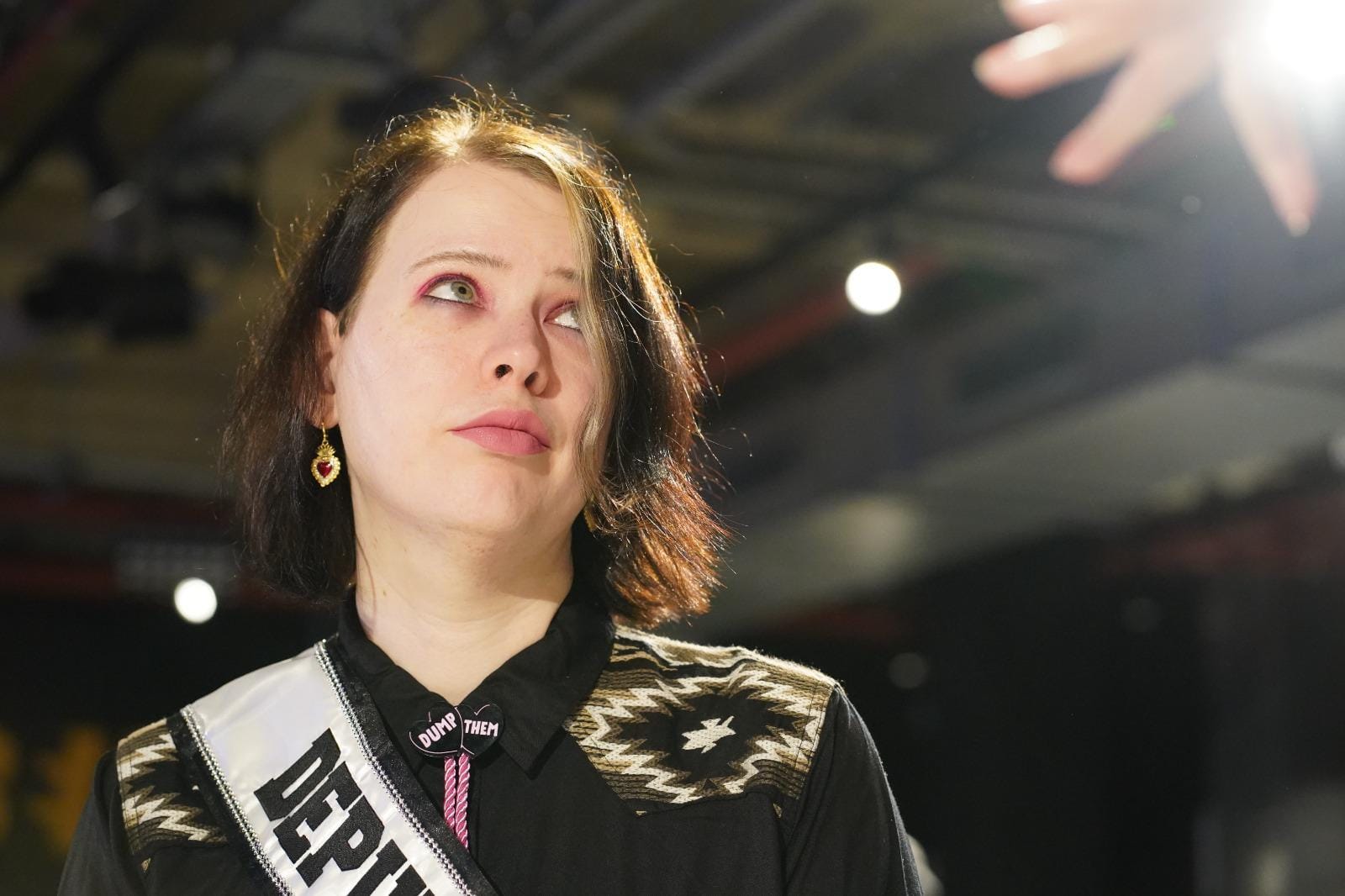
Caldwell supported her plan to transition. Kelly says her parents have been consistently supportive as well.
The medical establishment was another story. She and Caldwell both remember the process as humiliating and intimidating, with psychiatrists questioning them in excruciating detail while being reluctant to help her. Early on, Kelly asked about getting a short term prescription for estrogen to last until she could be treated by a gender identity clinic, which would assist her longer-term. It was something that was explicitly allowed.
“The first [general practitioner] I asked about it physically laughed in my face,” she said.
Still, Kelly was put off by the idea of DIY hormones, so she endured a year of this treatment to get prescriptions and start the legal transition process. She changed her name to Alice, and eventually left law school, overwhelmed by the combination of the workload and the stress of transitioning.
She was, in her words, “still deeply unemployable as a mentally ill transsexual.” Since she couldn’t hold down a job, she got funny on Twitter, and built a following in a way people still could in the 2010s. Caldwell recalls her accumulating 40,000 followers in a few years. Between her trans identity, her Marxist-Leninist politics, her sense of humor, and some trolling, she periodically made UK Trans Twitter or Left UK Twitter very angry at her.
“I found her so annoying and repellent at the time that I blocked her,” her now-wife Gwen remembers.
More difficult was that Kelly was repeatedly targeted by online transphobes such as onetime television writer Graham Linehan, who publicly fumed about her as recently as last year.
“I don’t think she was prepared to be a public person,” Caldwell remembers. “As talented and clever and as good at her job as she was, her idea was that I was always going to be the famous one.”
They say she was thrust into niche fame quickly and was befuddled, but touched, when people approached her on the street to thank her for making them laugh, or for making them feel less alone. She slowly got used to it. Kelly and her co-hosts like to reuse the Bond villain quip, “We have people everywhere”, but it’s not really a joke. One fan at the Catalina Sky Survey, an asteroid- and comet-discovery project based in Arizona, named a Mount Everest-sized asteroid between Mars and Jupiter after Kelly last year.
Caldwell worked long hours at a project that assisted unhoused people at that time. They also advocated for Kelly with universities, trying to get her programs to support her so she could handle her studies.
She remained very active on social media. It’s possible that nothing Kelly has said or done attracted more criticism than her conversion to Islam in the late 2010s. It’s the one time in our conversations that she seems stung by the public reaction:that she was faking it for attention. She maintains that her past attempt at religious life was motivated by seeking truth.
“It was a beautiful time in my life in a lot of ways,” she says, but adds that she recognized it was “spiritually unsustainable” for her. “I still have the prayer time reminder app on my phone. I always scroll past it, but I can’t bring myself to quite get rid of it.”
Still, her status as a British Muslim and her online following led to an invitation from Kesvani to appear on a new podcast called Trashfuture in late 2018.
“Happy to be diversifying your male brocialist podcast by being a guest who just sounds like a male brocialist,” Kelly quipped right after the hosts introduced her on air. She fit right in, and a few fill-in appearances later, she was invited to join the regular cast in August 2019. Weeks later, she and YouTuber Justin Roczniak (a structural engineer and repeat Trashfuture guest) launched a project that they hadn’t named yet, a show where they talked about engineering catastrophes by illustrating their flaws, along with their jokes, with visuals they put on YouTube.
For the next episode, they named it Well There’s Your Problem.
Like a lot of young leftists, Kelly had listened to Chapo Trap House and to shows like Grubstakers (which took on billionaires in the way that No Gods No Mayors does with local electeds). She’d never seriously considered podcasting before getting the offer, and she says she mostly learned on the job from Quinn.
“I think this is something the two of us have worked out: the most important thing is that everything you’re saying has to have a reason,” Quinn says of their approach. “That can be ‘this is funny,’ but when that’s exhausted, you have to move on.”
5. Future
While being funny and erudite is Kelly’s calling card, her vulnerability also seems to pull people in. It may stem from the signs of how hard she’s had to work to become herself. There are always traces of the intelligence officer she tried to be: Kelly makes frequent use of the salute emoji in texts, she’s an expert on military history and machines she’d have used in an intelligence career, like firearms, cameras, and watches. From a distance, she admits to feeling some regret that she didn’t get to be that person, even knowing that she’s better off today.
“I don’t subscribe to the idea that you’re not the same person” after transition, she says. “It’s very easy to explain to cis people ‘the person that I am now is right, and I’m sort of unimaginably different from the life I could have had if I had not transitioned,’ and that’s all true, but you’re still in the society. You still have all the stuff.”
Like a lot of millennials, Kelly is very conscious of the idea that as a child, she was told a certain kind of world was coming—one where racism and sexism and even transphobia were going away, and that freedom was ascendant.
Here’s where the yogurt ad comes in: She sums up this unfulfilled dream as the “solarpunk yogurt ad” future. It’s a joke about a long, Hayao Miyazaki-style ad that Chobani put online a few years ago. It shows a green solar-powered future where people of all ages, races and disability status live together in harmony. It stuck with Kelly in part because it’s called “Dear Alice”, the name she used for years after transition. But the utopia was just a cartoon made to sell glop. As Kelly came out and transitioned, she watched that possible future slip away, and be replaced by something much worse overall, for her and the people she cares about most.
It’s easy to see how that would make someone deeply pessimistic, especially if they’re a trans Marxist who is prone to depression. Kelly says she’s more optimistic than she tends to sound. Yes, she was gutted when the UK Supreme Court ruled that trans women aren’t legally women (she says she didn’t go out for three weeks afterward), but she really does think the victory of the proletariat is inevitable.
“I do come back to this idea of pessimism of the intellect, optimism of the will,” she says. “We are in a time where, yes, there is unutterable barbarism happening. I don’t think it’s going to win. If you want to get into the religious aspect, I don’t know that it matters if it does win. What matters is being true to yourself and being right in the first place.”
Until then, Kelly can make a living joking about the collapse of that promised future, and the dystopia that’s emerging in its stead. Podcasting proved to be a steady job that worked for her, and as she gained experience, she met more funny people and thought up new show ideas.
Her Patreon income grew to the point that she could support herself and Caldwell. After Caldwell had a life-threatening health crisis in 2021, Kelly talked them into leaving their job to concentrate on writing fiction. They’ve made it a career: Their first book, “Call and Response: Stories of the Fantastic,” was published in 2025, and recently won the Crawford Award from the International Association of the Fantastic in the Arts.
Despite Caldwell’s support for her transition, it had gradually transformed their marriage into something else. Their relationship had always been open, but Kelly came to identify as a lesbian while Caldwell was nonbinary and attracted to men. Caldwell says things deteriorated after a series of deaths in Caldwell’s family, and it became obvious the relationship wasn’t working.
As that was playing out, Kelly met Gwen, who had transitioned in the intervening years and hadn’t stopped thinking about her.
“Someone wound up making a move for me, and we wound up in sort of an awkward throuple type situation/pincer movement type attack that was more coordinated by the other person,” Gwen says. When it was just the two of them, everything had changed.
“On our first date, which lasted seven days, we had exchanged ‘I love yous’ by the first night and were engaged by the third,” Gwen says.
This led to difficult conversations for Kelly and for Caldwell.
“I think both me and Chris kind of knew, or had known for a while, that what we were in was not really the relationship that we had been in,” she says. “It was affectionate but it wasn’t really romantic in the same way.”
They remain close today: Caldwell became a U.K. citizen this year, and she attended their U.K. naturalization ceremony.
“They’re a very kind and a very patient person and I feel very lucky to have Chris, and have Gwen, and have all my other partners in my life,” Kelly says.
Gwen isn’t big on podcasts, saying only one of Kelly’s shows she listens to regularly is Kill James Bond. Still, she says that years of listening to Kelly and interacting with her have shaped her own sense of humor. They spent her 35th birthday in Dublin, and have mused about a trip around Europe, but Kelly’s intensive research and recording schedule doesn’t leave a lot of time for travel.
Kelly admits she’s often exhausted and sick from her workload, but contends that in 2026, she would be feeling bad regardless.
“I would find stuff to be stressed about anyway. It’s not like there’s a shortage, particular for trans women,” she says.
At least for now, she’s not about to start any more shows. She wants to try making physical things that won’t get locked into an online format or platform. A longtime photography hobbyist, Kelly is planning a project featuring infrared art photos of trans people. When she has to unplug completely, she turns to calligraphy. She and Quinn are also developing a board game called Shadow Doge. It grew out of a Trashfuture joke; the goal is for the players to ride out the decline of Renaissance Venice by securing cushy jobs for their doofus children.
And as for James Bond? As of No Time to Die, he’s dead, and he’s also the creation of a dead writer, adventurer in a dead Cold War on behalf of a dead British Empire. Kelly knows he won’t stay dead, but she thinks it would be better for everyone if he did.
“The basic thesis is that Bond as a franchise is like Britain—trapped between capital and nostalgia and doomed to keep repeating the same thing less and less coherently,” she says. While it looks like the Bond franchise will start all over again by setting its next movie in the Sixties, keeping Bond further than ever from the real country he’s supposedly defending, Kelly contends that we’d be better off. It’s why the podcast’s motto is “Kill the James Bond in your head”.
“A post-Britain Britain could be a better place than it’s been allowed to be,” she says. “He’s a National Security blanket in every sense. We have to give him up.”
This, then, is how it always goes—neither fast nor furious, but a secret third thing. The solarpunk yogurt ad future was never coming. Transition doesn’t magically make you into the person you always wished you’d been if you’d only known, only had the chance. But you’re here, for now. The mess is all there is. You’re the one who decides what to do with it. It starts with choosing to live with yourself. If you want more than this world is offering you now, you’re going to have to fight for it. You might win and you might lose and you WILL suffer, and you’ll watch it happen to everyone you love, but: You Can.
Editor's Note: A few minor changes have been made to the article, such as changing what color Kelly's eyes were listed as.