
Interview: Zoey Carter Talks Small Town Progressive Politics

by Jane Migliara Brigham
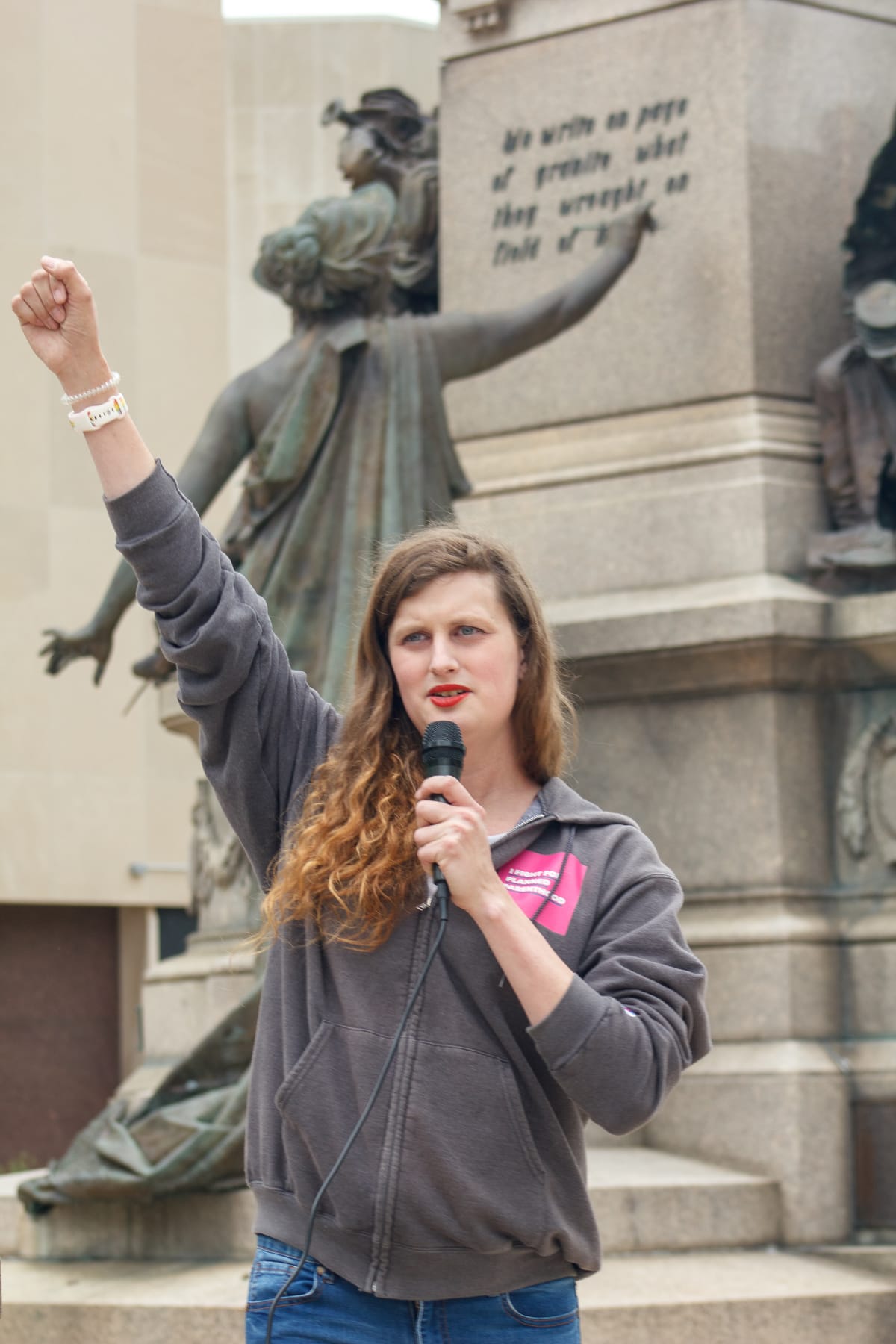
Zoey Carter is running for State House in rural Illinois as a progressive. She spoke to The Needle about her plans for the area, and her work in building there.
The original interview has been edited down for time and clarity.
Jane: With us today is Zoe Carter, a candidate for state office in Illinois. Would you like to introduce yourself?
Zoey: My name is Zoe Carter. I am the candidate for the Illinois State House of Representatives here in District 93. It's a very large district, but it's just because I've lived my entire life. I'm an eighth generation Pekinite. So I'm from Pekin, Illinois. It's a little town just south of Peoria, right in smack dab in the center of the state and on its own.
Jane: Can you set the scene of the area?
Zoey: So the district is, again, very large. About 620 square miles in size. I think actually it might be bigger than Rhode Island. It's a partially rural district, but with many suburbs.
I live in Pekin. It's a town of about 33,000 people. It's the largest town in the district. It's where I've lived my entire life. My mom was one of the founding families of my hometown. So we've been here for 200 years.
The rest of the district is a lot smaller, with 1000 to 2000 population towns. A lot of it is very focused on farmers, of course. So, but it's, it's beautiful. I love it here. We've got fantastic, wonderful parks. I adore the scenery. A lot of people find me crazy with that. I love it here. It's one of the big reasons why I'm running for office, because I love it so much. And we need positive change.
Jane: Let's segue into that. Why are you running for office? And why this office in particular?
Zoey: I'm running for this office specifically, because again, it's a very rural district minus the two cities. And so, when it comes to Illinois politics, it seems like it's two sided. You have Chicago, which is the majority of the state out of a population of about 11 and a half million people, give or take. The problem with that is a lot of downstate residents feel like we are left out, both Republicans and Democrats alike.
It feels like a completely different state than up in Chicago. Because of that, there's a lot of things that we have failed our citizens on. A lot of these towns are lacking in infrastructure. There's healthcare and food deserts.
A lot of these people have to drive an hour just to get groceries. And Illinois has ways to combat that. There's just not that voice in Springfield that is willing to help, and work to eliminate those food deserts and healthcare deserts.
The representative that we have in right now is proud to say he's a conservative. And that's all he does. Meanwhile, the people in charge of the town have been doing good things. In my school board, it's fairly progressive. And so I asked which office should I run for.
I realized the best place for me is in the state house. I’ll be able to change things like these food and healthcare deserts, and to curtail AI data centers, which are causing the utility bills to skyrocket. And the simple one, to fix our damn roads. There's miles and miles of country roads that I feel like I'm off roading when I go down them.
Jane: So the second you leave the Chicagoland area, and go into actual rural areas, the situation changes drastically. I mean, that's the same with every rural area in the US. It's the same way with New York, where the city is so developed. But go north of Westchester County, and you are in the sticks.
Zoey: Exactly. I could sit here like everyone else does and complain about the problem, or I could actually do something to change it.
Jane: You mentioned your opponent, who says he's a conservative and does nothing else. I looked at the Ballotpedia article on him and your district, especially with the last election. If I remember correctly, the other guy won by a margin of about two to one. Is that the vibe you get from your district?
Zoey: So first off, the problem is he didn't win two to one. He won unopposed.
Jane: No, I mean the last contested one.
Zoey: Well, the last contestant won, it was two to one. But the problem with that is if you look at the maps, district 93 then was in a completely different spot in the state. That being said, I understand what I'm doing and what I'm running against. And the vibe that I have in the district now is not two to one. People in the district want to see simple things. They want to be able to afford the food on their table. They want to be able to afford gas in their car, their healthcare, and they don't really care who's in charge of doing that.
If you look historically, the northern part of the district voted Democrat up until 2016. My hometown of Pekin was a Democrat city until I think around 2000-ish. We had Democrat mayors and a Democrat city council. Just this year, we elected our first LGBTQ city council member.
Jane: So your strategy, essentially, is to offer a viable opposition in a district that has some history with the Democratic Party. Am I getting that right?
Zoey: Oh yeah, 100%.
Jane: So you're very much focused on the rural Democrat angle, which I find interesting, because there's fewer and fewer rural Democrats over time. So I want to see how you're going to be selling that to your constituency.
Zoey: I don't think there's less and less rural Democrats. I think more and more rural Democrats are going into hiding.
This post is for subscribers on the Silver Needle, Gold Needle, Platinum Needle, Silver, Gold, Platinum, Diamond and Diamond Needle tiers only.
Subscribe now and have access to all our stories, enjoy exclusive content and stay up to date with constant updates.