
Internal LGBT+/Queer migration within the US under Trump at highest levels ever recorded
In every way that queer people as a whole have suffered, trans people have suffered worse. 9% of trans people and 5% of the queer population moved from a less tolerant state to a more tolerant one within 7 months of Trump’s re-election.


One in ten trans people in the US moved to a new state after Trump’s re-election
By Jane Migliara Brigham & Artemis T. Douglas
A new study, conducted jointly by the Movement Advancement Project (MAP) and NORC at the University of Chicago offers what MAP claims is a “nationally representative sample” of the United States’ queer and trans population. The study reveals increases in discrimination, harm, and participants making major life changes since Trump was re-elected.
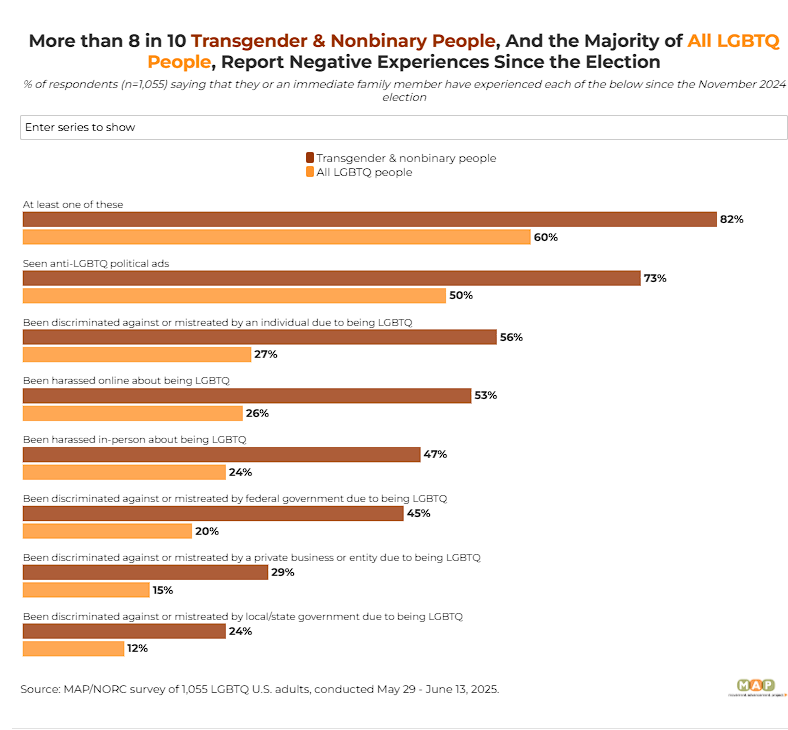
Among the study’s insights are that a majority of queer people - and more than 8 in 10 trans people - have had negative experiences because of who they are since the 2024 election. Those experiences include being harassed, seeing political ads opposing their existence, and other harms.
As for major life changes, trans and queer people are making choices that include moving to a different state, changing how visible and “out” they are among the general public, changing jobs, or changing their legal documentation.
Interestingly, more trans people than the broader queer population are making changes with regards to their visibility in both directions, either trying to be less visible or more visible.
The data shows that 24% of queer people broadly and 55% of trans people have taken steps to be less visible and “out”, whereas 18% of queer people and 31% of trans people have taken steps to be more visible.
The data shows a pattern of trans people being more affected than the broader queer population. This is reflected in how trans people were more likely to suffer from every form of discrimination that the study asked about, and were more likely to take every action to address these harms that the study asked about, than the broader queer population.
According to the study's research brief, as much as 5% of the US adult population that is queer have moved to a more tolerant state in the 7 months since Trump was re-elected. If that is a representative sample of the entire queer population of the US, then that's possibly 1.25 million internal refugees within 7 months from November 2024 to June 2025.
The study also found that 25% of queer people and 43% of trans people have considered moving to a different state.
This is especially notable since Americans moving homes is at the lowest level since modern records began in the 1940s.
That queer people appear to be more willing to move as the rest of the country is more likely to stay put shows that queer people are both highly motivated to escape discrimination, and perfectly willing to be outliers from the cis people around them in order to achieve that goal.
All this is profound evidence for the idea of a pink migration, the mass migration of queer (and especially trans) people to more accepting regions of the US and the world.
Support our news and culture coverage by becoming a Bronze Needle member, for $5 a month.
The study also showed profound shifts in how trans and queer people are building communities.
In short, 20% of queer people and 42% of trans people have joined or started participating in local queer advocacy and activism. 21% of queer people and 38% of trans people “joined or started participating in LGBTQ community or recreational opportunities” in their area.
The wording is notable, as the numbers only include activities that the respondents began since the election. Presumably, there is some number of people who were already doing these things who were not counted in this poll.
This will provide more in-person opportunities for not social ties between them, but for homosocialization and transsocialization, the ability for these groups to develop customs and norms outside of the influence of the cishet majority.
On the one hand, this is an excellent opportunity to develop distinct cultural norms that can be used to unite the group.
On the other hand, this is only happening because of the resegregation of American society along the lines of sex and sexuality.
Members Discussion