
Supreme Court hearing on trans kids in sports spells danger for legal protections
There is no likely ruling that does not leave trans people in the United States worse off than they were before.


These cases are all but certain to be decided in favor of the anti-trans defendants.
By Jane Migliara Brigham & Artemis T. Douglas
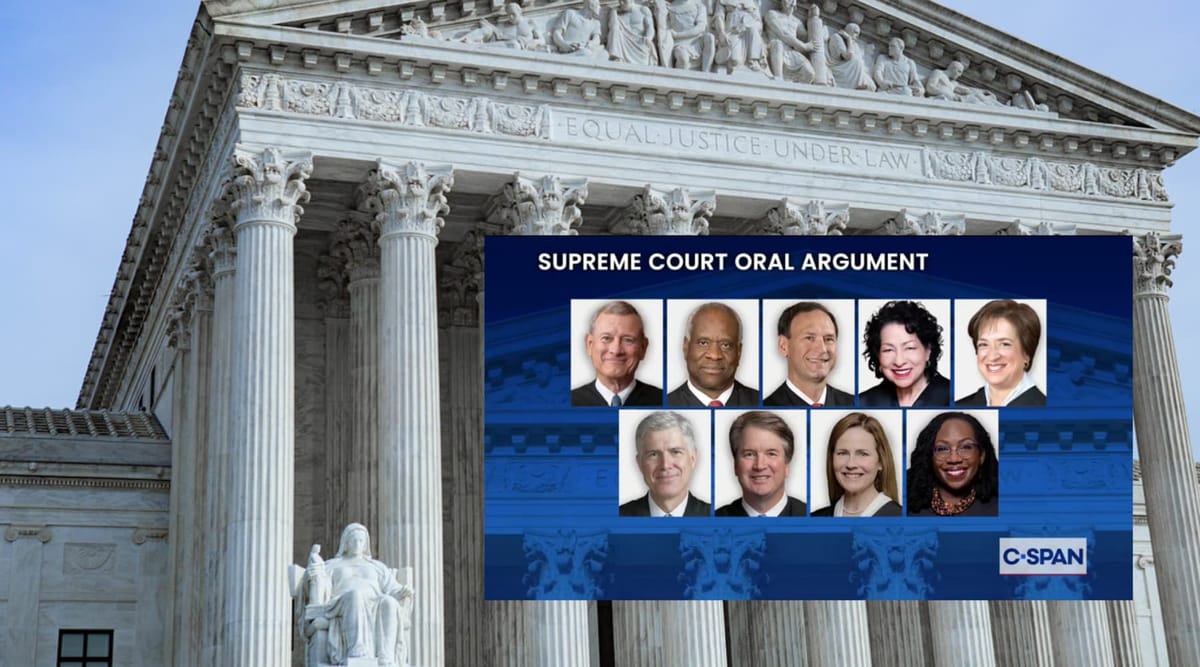
This morning, the 13th of January, the Supreme Court took up two cases challenging bans on trans people in sports.
The first case covers a trans college student in Idaho challenging a law which forces sports which have a distinction between men’s and women’s sections to bar anyone born male to play in the women’s section, implicitly barring trans women from playing sports with other women.
The second case covers a trans girl from West Virginia suing for the right to play sports at her high school. She is challenging a law limiting all sports divided by sex to a person’s sex at birth, leaving her no way to play sports that does not out her to her classmates.
Both cases were taken one after the other due to the many similarities between them.
At issue in both is the definition of sex as it applies to legal classifications, as well as how to handle laws which have a disparate impact on trans people but which do not explicitly discriminate based on the fact that a person is transgender.
Gender and Sex as Distinct Legal Categories
It is important to make clear that in the American legal system, a person’s sex and their gender are separate categories. It recognizes that a person can change their gender and that it is illegal to discriminate against people based on their gender (Bostock), but that sex is immutable and it is not illegal to discriminate against people on the basis of sex if there is a justification can be provided as to how they can gain similar service elsewhere (Skrmetti).
This distinction has guided the writing of all anti-trans legislation and much of the anti-trans rhetoric since Bostock, when gender identity was ruled to be a protected characteristic under the 14th amendment.
This is why anti-trans politicians and speakers are reluctant to talk about gender in general and trans people in particular when they are discussing policies that would restrict the freedoms of trans people. They need to play within a legal framework where trans people have the right to sue for discrimination.

If you support our coverage, consider subscribing to The Needle as a Gold tier supporter, at $15 a month- you'll get access to all articles!
Implicit Discrimination
Both sides tailored their arguments to comply with the ruling in Skrmetti. That case found that a law which had a disparate impact on trans people cannot be considered discrimination so long as the trans person is still allowed to act as their assigned sex at birth.
In other words, legal discrimination against trans people is allowable, as long as it remains de facto.
The distinction between de jure discrimination and de facto discrimination is important here. De jure discrimination means that (for example) trans people are barred from a certain activity on the basis that they are trans.
By contrast, de facto discrimination would mean that trans people are not barred from an activity outright, but that they face a set of restrictions that would make them uniquely unable to meet the requirements, meaning that all or most of them would not be able to partake in that activity.
Both laws being challenged today have de facto restrictions. They discriminate against trans people by requiring sports separated by sex/gender to only allow players who were assigned to their coercively assigned sex at birth. This is a requirement that all cissexual people are able to meet, but which no transsexuals are able to meet.
In other words, they discriminate against trans people as a second order consequence of the law.
Hashim Moopan, counsel for the anti-trans defendants, made this distinction clearly. Moopan emphasized that the laws in question discriminate based upon a person’s sex rather than their gender identity, as is required under Bostock.
He stated that only gender identity is a fully protected class based upon standing interpretations of the 14th amendment, any de jure sex discrimination which would lead to de facto disparate harm on the basis of gender identity is not a form of legally prohibited discrimination.
This interpretation is consistent with how the Court ruled in Skrmetti last year.
The lawyer for the pro-trans side emphasized that trans people have a history of suffering not just from de facto discrimination, as in the case of formerly widespread crossdressing laws, but also from de jure (explicit) discrimination, such as immigration bans on trans people, which were on the books for decades.
Legal Definition of Sex
The trans plaintiff’s lawyers contend that they don't have a legal definition of sex, and that they don’t need one for their case to be heard.
This is a major misstep, as the defendants (anti-trans side) claim that sex is determined at birth and immutable.
The defendants further argued that due to the supposed immutability of biological sex, trans people can be discriminated against on the basis of sex, and that this does not discriminate based on gender identity.
Since the pro-trans side didn’t prepare a definition of sex, the transphobic and false notion that sex is based on a person’s visible genitalia (referred to as their “biology”) at birth remained undisputed within the Court.
Early in the oral arguments for the first case, Justice Sotomayor– an Obama-era appointee to the Court, went so far as to say “there is no dispute that a male who identifies as a female is being denied from a female sport."
The same language used to describe trans women and girls was effectively shared by Justice Sotomayor and Alan Hurst, the Idaho Solicitor General, who was arguing on the side against trans people, and in favor of the Idaho law at issue.
In other words, both Justice Sotomayor and Hurst used “identifies as” language, and framed trans women and girls as essentially and unchangeably male.
Hurst also stated "The record does now show that 6 year old boys have a competitive advantage against 6 year old girls." This is a claim that “biological advantages” start before puberty, which is an escalation in anti-trans rhetoric.
The lawyer on the pro-trans side did say that HRT “changes sex characteristics”, but stopped short of the true but more radical claim that HRT changes one’s biological sex.
This would have allowed them to have a working definition of sex, which could’ve been an opportunity to present evidence to the court of the changeability of human sex, and how transsexual medicine actually changes one’s sex in very real and material ways.
Providing such evidence and legally disputing the supposed immutability of sex would’ve been a morally correct strategy and likely made a stronger legal case.
Even the anti-trans arguments reflected this. Hashim Mooppan, the Principal Deputy Solicitor General for Idaho flat out said that if sex were proven to not be immutable, his entire case would collapse.
Both sides heavily mentioned the cases Lehr and Caban, which both dealt with biological or natal lineage.
The Lehr ruling held that an unwed biological father need not be recognized as the father if the woman marries another man.
Caban was about due process, anti-discrimination, and the equal protection clause regarding unwed parents and adoption, but the Court only ruled on the equal protection clause.
Anti-Scientific Use of “Biology”
The anti-trans side arguing in favor of the Idaho law claimed at multiple points that sex is determined at birth and immutable. This is neither biologically accurate, nor is it socially relevant.
The anti-trans insistence that sex is immutable reveals the gender ideology that they defend. It is a patriarchal ideology that transphobia is defending. Transphobia defends patriarchal notions of reproductive and social control, as well as division of labor on sexed lines.
Human sex is neither binary nor immutable. The existence of transgender people and the power of transsexual medicine to change an individual’s sex prevents people from being classified within patriarchal systems, undermining their ability to coerce people to their will.
By claiming that biology backs up their transphobic arguments, the anti-trans defendants are revealing their own bias and gender ideology.
Of course, biology does not support them. Human sex is bimodal, not binary. Gender is another story altogether, but neither can be fully removed from the other.
SPONSORED
Please consider signing up for one of our paid subscription tiers. They start at $5 dollars a month.
Legal Ramifications
These cases are all but certain to be decided in favor of the anti-trans defendants. The court is composed of the same nine people who stripped away trans rights in Skrmetti and Orr.
The cases from the anti-trans side were tailored to build upon the right to discriminate on the basis of sex as laid out in Skrmetti, but without claiming the right to discriminate on the basis of gender identity, which was ruled illegal in Bostock. They were using the very logic that delivered the anti-trans legal movement a 6-3 win in Skrmetti last year.
This could have profound legal ramifications for sex discrimination in general and trans people in particular.
The first possible consequence is that the court could codify a definition of biological sex in the judiciary that makes it explicit that biological sex cannot be changed from birth.
In Orr, they deferred to the definition as it is used by the executive branch, but the Supreme Court has yet to adopt it within their own internal rulings.
Another possible ruling is that the disparate impact of sex distinctions on trans people could be declared to be insufficient grounds to strike down these laws. This would expand the anti-trans loophole carved out by Skrmetti into a general policy on how to craft discriminatory laws against trans people.
There is no likely ruling that does not leave trans people in the United States worse off than they were before.
💡
💉Take Your Shot 💉
Buy your trans friends pizza and donate to their GTFO funds.
Buy your trans friends pizza and donate to their GTFO funds.
Members Discussion