
US-based hate group behind rise of anti-trans science and standards worldwide
SEGM has spent almost $1.5 million dollars and received nearly $2 million to push anti-trans hate into "scientific" legitimacy and "evidenced based" objectivity.


Society for Evidence-Based Gender Medicine has been funding studies to dispute the quality of evidence for transition healthcare and intervening in courts and newsrooms against transition.
By Artemis T. Douglas and Jane Migliara Brigham
Editor’s Note: This article is the first in a series of articles investigating the anti-trans hate group known as the Society for Evidence-Based Gender Medicine. The other parts will be released as it progresses.
Additionally, the header/cover image for this article was updated on Jan. 6, 2026 to better reflect its position as part of a series of an ongoing investigation
An investigation by The Needle has found substantial evidence in public records that SEGM have commissioned multiple systematic reviews, paid for the publication fees for at least 28 scientific articles, and advised on draft clinical guidelines across the US and the world.
These activities are evidenced in part by the 2020 through 2023 financial filings the organization filed with the IRS.
SEGM, the Society for Evidence-Based Gender Medicine, which is a US-based non-profit labeled by the Southern Poverty Law Center (SPLC) as a hate group, has been directly funding and influencing academic and scientific literature surrounding trans people to fit an anti-trans narrative.
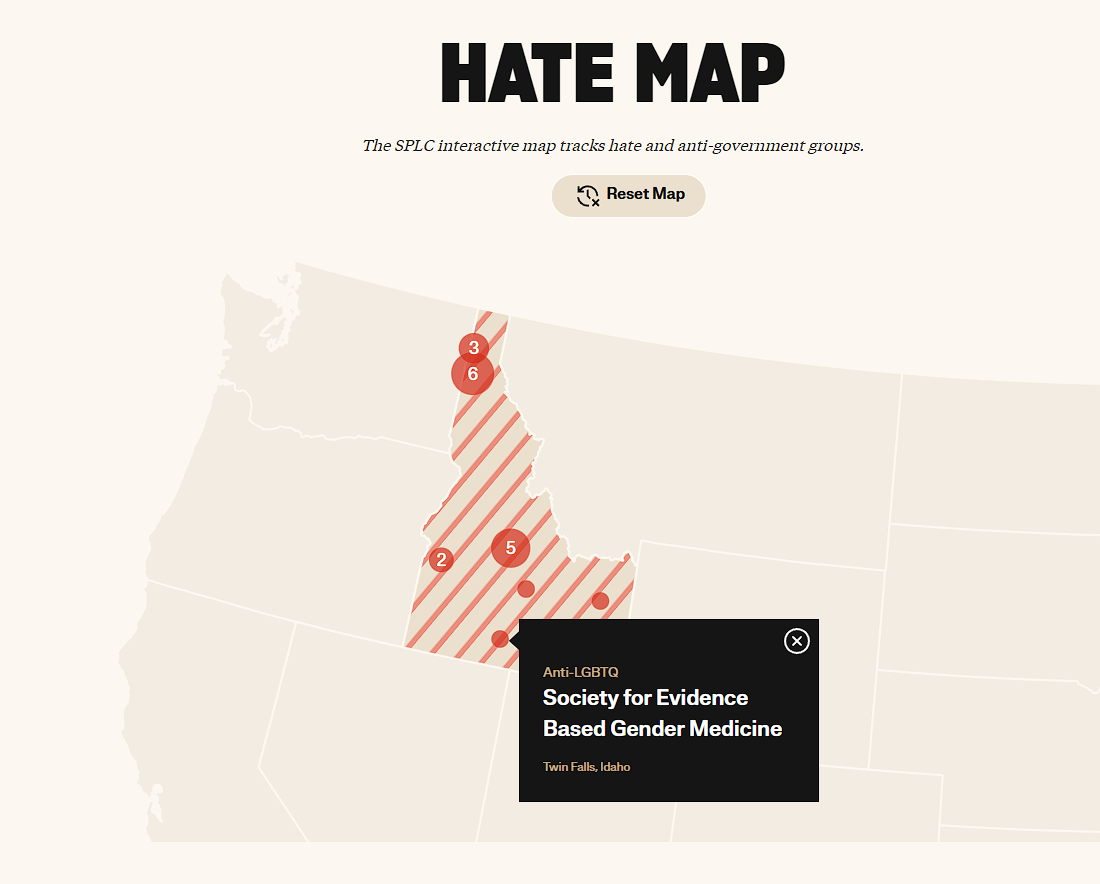
SEGM can be found on SPLC’s Hate Map using 2024 data.
The organization presents itself as an alternative research organization, but is regarded by established researchers in the field of transition medicine as a "fringe medical association", whose attitudes regarding medical and social transition are wildly outside the accepted standards within the field.
The organization has only existed since 2020, but it is responsible for over a million dollars worth of studies and activities that push an anti-trans agenda.
Financial Backing
Available financial data on SEGM goes from 2020, the year it was founded, to 2023, past which public records are not yet available.
In 2023, SEGM received $773,296 in contributions. In 2022, it received $229,683. That’s over $1 million USD in funding from donations across two fiscal years.
For 2021, SEGM received $793,975 and in 2020 that number was $199,566.
In its first four fiscal years, SEGM received almost $2 million USD in contributions.
SEGM does not make its full financials public. Their 990 Schedule O for each year states, “the organization does not make governing documents, conflict of interest policy, and financial statements public.”
However, what is public is how much they spent each year, and an executive summary of how the organization spent its money.
Per the 990 filing for 2020, they didn’t spend much as compared to later years, around $72k USD.
Their output summary was as follows,
“Created website and print collateral; launched website and social media accounts; curated key developments in the field of gender medicine in 2020; published a study evaluating the quality of a key sample in transgender research (us transgender survey 2015); funded open access fees for publications to enable wider dissemination of key research.”
Amicus Brief
In 2021, according to the 990 filing, they spent $129,238, for what they summarize as follows,
“Collaborated with more than 350 clinicians on a range of projects, from evaluating the evidence for hormonal and surgical treatments of gender dysphoric youth to disseminating accurate information to medical societies. Creating an online compendium of publications in scientific journals that highlight scientific debate regarding how to best care of gender dysphoric youth. Created and distributed monthly "Spotlight" of important international developments in the field of gender dysphoria management. Consulted a range of news organizations, fact-checking accuracy of claims. Provided feedback on international and US practice guidelines. Submitted an amicus brief to the 9th circuit court of appeals. Paid open access fees for 9 publications to make them available to the general public free of charge.”
To break that down, this is SEGM saying that they have been pushing clinicians, medical societies, researchers, newsrooms, and even the courts in their direction.
The Needle found the amicus brief in question. It essentially argues that the risks of medical transition are too great for it to be allowed to be given to minors, and says that the evidence in favor of allowing them to transition is far too inconclusive to be trusted.
This flies in the face of all existing evidence on the topic, which has made it clear that medical transition is directly responsible for the mental and physical betterment of transsexual children.
A comprehensive, or systematic, literature review on the topic found that the regret rates for transition-related surgeries is under 1%. This is noticeably lower than the typical regret rate for surgery of around 14%.
Given that SEGM is directly responsible for funding anti-trans studies, their dismissal of the many pro-trans studies which contradict them is not only immoral, it demonstrates a clear conflict of interest.
That amicus brief was for a case in which a then-teenaged trans man sued the Arizona Medicaid program for refusing to pay for his top surgery.
The Arizona Daily Star later reported that the court ruled against this man’s appeal and that the judge, “pointed out that Doe is only 17. And she said there is evidence that some teen transgender males go back to acting as females on their own, regardless of whether they have surgery to alter the appearance of the top half of their bodies.”
Those arguments can be found in the amicus brief submitted to the court by SEGM, as well.
Draft Clinical Guidelines
In 2022, SEGM’s 990 filing reveals that they spent $428,408 on the following:
“Provided expertise and detailed feedback to draft guidelines for the clinical care of young people with gender dysphoria in the US and internationally including Canada, Australia, Sweden, Norway, and Iceland. Published translations and key summaries of developments in the field of youth gender dysphoria, maintaining the role as a trusted source of information. Fact-checked key publications to present accurate information to the public. Maintained an online compendium of publications in scientific journals highlighting the scientific debate regarding how to best care of gender dysphoric youth. Paid open access fees for 11 publications to make them available to the general public, free of charge.”
What this means is that SEGM is pushing their anti-trans perspectives across multiple languages, working with newsrooms and others to perform fact-checks, and highlighting research that they believe helps their mission.
These would be potentially benign if not for the anti-trans part. A non-profit pushing for its mission by acting as an expert seems normal, doesn’t it?
SEGM only received $229,683 in contributions that year, meaning they spent over $200k USD from their accrued contributions from prior years.
Funding for Meta-Analyses
In the final publicly-available 990 filing, from 2023, SEGM spent over three-quarters of a million dollars - $754,664 - with the following public summary:
“Hosted and/or provided organizational support for two international conferences, which brought together leading clinicians and researchers with a range of perspectives on the etiologies, assessment, and treatment of youth gender distress, as well as experts on evidence-based medicine. Commissioned five systematic reviews on the subjects of social gender transition, tucking and binding, 'gender-affirming' mastectomy, puberty suppression, and cross-sex hormones. Paid open access fees for 8 publications to make them available to the general public, free of charge. Provided regular updates and in-depth analysis on developments in the field of youth gender medicine via our website.”
We will be discussing their conferences in a future edition of this investigation.

If you support our coverage, consider subscribing to The Needle as a Gold tier supporter, at $20 a month- you'll get access to all content! For a limited time, you can get half off your first three months!
For now, what is noteworthy is their claim that they have commissioned five separate systematic reviews of research on the topics of transsexual medicine and social transition.
Systematic reviews are expensive and take a long time to complete. According to a study published in 2019, systematic reviews in medicine cost an average of $141,194. According to the University of New Mexico Health Sciences Library & Informatics Center, systematic reviews take between 6 to 12 months, at minimum.
It is safe to say that those 5 commissioned reviews were likely their biggest expenditures in 2023.
It is generally known among academics that peer review before publication takes, at minimum, several months to a year, with lots of factors affecting the actual timeline.
The Needle couldn’t find evidence of SEGM announcing the results of these 5 reviews publicly, meaning they are likely still in process.
If SEGM’s commissioned systematic reviews follow a typical timeline, they likely won’t hit the academic or news literature until 2026 at the earliest. However, if these turn out to be rush jobs, they might come out sooner.
Conclusion
According to what is evidenced, SEGM has spent almost $1.5 million dollars and received nearly $2 million, all for the goal of pushing anti-trans hate into “scientific” legitimacy– from paying for open access on studies with anti-trans implications, to commissioning entire studies that align with their world view.
SEGM has also, per their own statements and filings alongside other evidence, acted as an “expert” source in the courts, clinical guidelines, clinical practice, and newsrooms.
💡
💉Take Your Shot 💉
Subscribe to The Needle to follow the rest of this investigation as it gets published. You can join for free below or click here to pick a paid tier.
Subscribe to The Needle to follow the rest of this investigation as it gets published. You can join for free below or click here to pick a paid tier.
Members Discussion