
Idaho passes bill to surveil trans kids, aiming to “close the social transition loophole”
Simply put, the bill’s restrictions will be made into a normal part of taking care of kids in Idaho. It creates a dragnet to watch and enforce gender-conformity on all children in Idaho.

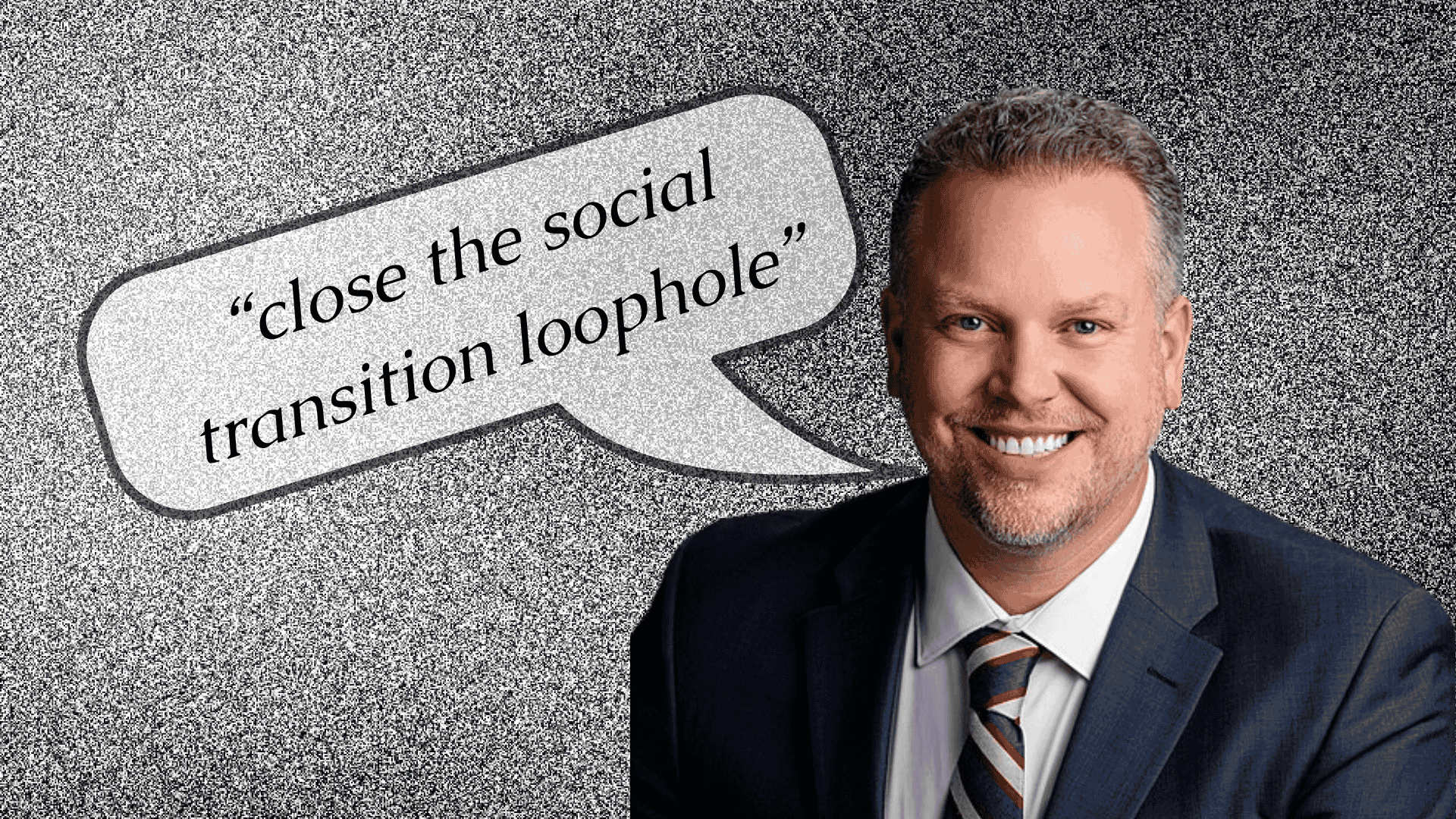
The bill, euphemistically called the “Pediatric Secretive Transitions Parental Rights Act”, is written with the goal of making it as hard as possible for children to socially transition via mandatory reporting to parents for any gender non-conformity.
Idaho is set to enact a bill mandating surveillance of kids by teachers, counselors, therapists, and others, all for one purpose: reporting suspected trans kids to their parents.
The bill, euphemistically called the “Pediatric Secretive Transitions Parental Rights Act”, is written to “close the social transition loophole”, as State Senator Ben Toews phrased it.
It has passed both the Idaho House and Senate with veto-proof supermajorities. The Senate added an amendment, meaning that as of writing it is headed back to the house. However, given that it has already passed the house with a supermajority, it is likely to do so again.
The bill is being debated alongside the state’s ban on trans people using public restrooms. The bill’s supporters are largely the same, as the goal of removing trans people from public life is also the same.
There is little chance of the bill being vetoed by the state’s Republican Governor. Even if it were vetoed, both chambers have enough votes to overturn any vetoes. The bill is all but certain to become law.
As passed, it will be the most comprehensive restriction on trans kids passed by any state government. These policies would make the open existence of trans kids impossible, except with the active consent of their parents.
Even with parental consent, the bill’s provisions function to effectively harass supportive parents via continued notice that their kids aren’t conforming to vaguely defined standards of gendered behavior and presentation which don’t conform to a kids’ sex at birth
1 The Law
The bill only needs two pages to accomplish its goals.
It does this by requiring “covered entities”, meaning anyone working at a “a primary or secondary educational institution, a child care provider, or a medical, behavioral, or mental healthcare provider”, to report “any request by the minor student to participate in or facilitate the social transition of the minor” to the minor’s parent or guardian. It also prevents any covered entity from “aiding and abetting" a child’s “efforts to socially transition”, including by using public resources to help the child in this.
Any violation of these rules can be investigated by the State Attorney General’s office, and/or be the subject of a lawsuit, either by the Attorney General’s office or by the child’s parent or guardian. Penalties can go up to $100,000, in addition to injunctive and civil relief.
If a person has been found in violation of this law, the Attorney General may refer the person or entity to any licensing boards relevant to their profession. Those boards are then encouraged to discipline the person/entity in a manner which the board deems appropriate.
When this bill becomes law/ it will take effect on July 1st. This means it will be in place by the start of the upcoming school year.
1.1 Defining Social Transition
The definition of social transition put forward in this bill is vague. Quoting from the text,
"Social transition" means the process by which an individual goes from identifying with and living as a gender that corresponds to the individual's sex to identifying with and living as a gender different from the individual's sex and may involve social, legal, or physical changes, including adopting a name, pronouns, appearance, or dress that does not correspond to the individual's sex.
[Emphasis added by The Needle]
The text lists a number of things a child can do that constitute social transition (adopting a name, pronouns, appearance, or dress that does not correspond to the individual's sex).
However, the language is written such that there is no clear limit on what does not constitute social transition. As a result, whether or not some behavior which is not listed here actually constitutes social transition will be in the eye of the beholder, or more accurately, in the eye of whoever is reporting the behavior to the child’s parents. This ambiguity leaves room for personal judgement, especially where that judgement is informed by anti-trans bigotry.
It turns teachers, doctors, and others who fall under covered entities into a kind of gender secret police, by force of law.
For example, in the original draft of the bill (HB 572), the given definition of social transition was specifically written to include “mannerisms associated with a gender other than from such individual's biological sex.”
No more detail was given, but that is vague enough to include almost anything. While this language has been removed from the current bill, there is still nothing in the text to exclude mannerisms from a working definition of social transition. After all, nothing whatsoever is explicitly excluded from such a definition.
As a result, a child’s mannerisms alone could be enough to trigger concerns of their supposed social transition, depending on how wide the enforcement of the bill ends up being.
This loophole is as vast as it is concerning. If nothing is excluded from the definition, then anything could be included. This begs the question of what could be included. Does a boy wearing the color pink count as evidence of social transition? After all, the color pink is currently typically associated with femininity, and dress associated with a sex other than that assigned at birth is explicitly described as a sign of social transition in all versions of the bill, including the current one. Would covered entities be forced to report such behavior to the child? Neither the bill, or any accompanying information clarify this.
In all likelihood, what does and does not count as “social transition” will probably come down to whether the child is conforming to gendered stereotypes. After all, most casual observers cannot reliably tell the difference between a child who is trans, gay, gender non-conforming, or one who is simply socially awkward. As a result, what does and does not get reported to parents will, in all likelihood, be determined by bigotry and stereotypes, rather than any clear guidelines.
The legislation reflects a patriarchal animus taken to an extreme level of enforcement.
This ambiguity could be clarified by the sponsors of this bill at any time. This was the complaint made by State Senator James Rutki, when he said that "the definition of social transition is written so broadly it's hard to tell what it means".
Senator Toews responded by listing a number of behaviors that he viewed as red lines for reporting, such as asking to use different pronouns or a name associated with the opposite sex. However, he never addressed the question of which behaviors are specifically excluded from the reporting requirements.
1.2 Reporting to Parents
This bill requires that covered entities report any signs that a child might be trans to their parents and/or guardians within 72 hours. No allowances are made to allow them to withhold reports if they believe that doing so will harm that child. The requirement to report, as written in the bill/law, is absolute.
It also gives no indication as to how this is supposed to happen. How are entities supposed to log that the report has been made to the satisfaction of the law? What happens if the parent’s information is not on file?
These questions do not have any clear answers. The details will probably only be fleshed out when it is time to implement the law. Until its implementation in July, we are forced to speculate as to what this will look like.
In an interview with The Needle, Jenna Damron, LGBTQ Strategist for the Idaho ACLU, laid out the starkness of the proposed policy:
“There's no provision for the clinician to assess for safety. You have to tell the parents within 72 hours whether or not that makes the kid less safe. There's no provision in the bill for that, and that's very concerning. As I've spoken to providers, they're extremely concerned about that as well.”
1.3 Punishment for Non-Compliance
As mentioned above, any violation of these rules can be investigated by the State Attorney General’s office, and/or be the subject of a lawsuit, either by the Attorney General’s office or by the child’s parent or guardian.
Fines can go up to $100,000, and can result in the loss of one’s professional license. This would render them unemployable in their profession, so long as they stay in Idaho.
In some cases, losing a professional license in one state can lead to losing eligibility for the comparable license in other states. Loss of license would mean loss of one’s profession.

If you support our coverage, consider subscribing to The Needle as a Gold tier supporter, at $15 a month- you'll get access to all content!
2 Social Consequences
This bill will create a social environment where large sections of the population will be forced to watch over another portion, vigilant of any social infraction that might require them to report to the relevant authorities: their parents.
This is a surveillance society, one where informing one your neighbors is a normal part of life.
Such societies are incompatible with freedom in any meaningful form. To live in such a system would be more analogous to living under the eye of a secret police than under any system of equality.
Kids in Idaho will live in a surveillance society, where nearly every adult they encounter on a regular basis will be legally required to report any sign of gender non-conformity to their parents. Given the far-right political environment of the state, the consequences could be deadly.
This will force all kids to balance self-expression against the threat that such expression might be used against them by their parents. These parents are regularly exposed to far-right politics, and have the power to shut kids out of society if they do not act as the parents desire.
Combined with the ongoing panic around trans existence, these conditions will place Idaho kids under extreme scrutiny for signs of being trans. It is unclear to what degree a trans life could be seen as possible to kids growing up under such conditions.
Further, legislation like this would degrade the trust between kids and other adults, those who are not their parents, as many of those adults would be forced to snitch on the kids to their parents.
2.1 Effect on Kids
This bill will make it practically impossible for children to socially transition in almost any public setting. The only exceptions would be when children are not around covered entities, such as friends and/or family members, or in situations where their parent has signed off on a specific set of gender-non-conforming practices for their child such that any covered entities would be legally safe to not report that behavior.
This is a narrow set of circumstances which most kids will not have access to. As a result, most Idaho kids will be unable to socially transition (or even freely express themselves without a transition) without the knowledge and consent of their parents.
Any expression of a trans identity by a child, (or the suspicion thereof on the part of a covered entity, depending how widely this is interpreted in practice), must be reported to their parents within 72 hours.
This fact will place a permanent breach of trust between kids (trans or cis) and almost every adult they will regularly come in contact with.
At present, the only situation where these covered entities are required to report the actions of a child is in the event that they learn that the child is planning to seriously hurt themselves or others. Since most children have never been suicidal or homicidal, these requirements have never affected them.
This bill creates an entirely new type of behavior which must be reported to the relevant authorities. Obviously, the ones most directly affected by this are the actual trans kids, followed by the gender-non-conforming ones.
It’s gender enforcement taken to an extreme and, in many cases, deadly level.
They are put in a situation where parts of themselves which they might see as perfectly normal might either be used against them by their parents, or else potentially be used against the covered entity adult. If the entity follows the law and reports them to their parents, they will be exposed to any and all bigotries that their parents hold against trans people. If the entity does the right thing and withholds that information from the parent, and is later caught, the child has to live with the fact they possibly ruined that adult’s life by being honest about themselves. In either case, their being open about themselves will, through no fault of their own, lead to a great deal of suffering, either for themselves, or to the adults they are speaking to.
The only adults whom kids can safely confide in are those who are not covered entities, namely the friends and family of their parents. However, family and friends often share similar social and political beliefs to one another.
If a kid’s parents aren’t safe people to talk with about these things, odds are that the parent’s friends will be the same way. Since Idaho is one of the most conservative states in the country, the likelihood of such people being safe is unusually low. If this is the case for a kid, there may well not be a single person in their life that they can discuss such things with.
If a child is reported for being (or suspected of being) trans, and the parents are upset with this, they have a massive set of tools at their arsenal to restrict the lives of their kids. Idaho kids have among the least civil rights of any kids in the country, according to a source familiar with the state. This manifests in all aspects of youth life.
To start with the most obvious example, conversion therapy is legal in Idaho, provided it is not done by licensed practitioners. Parents opposed to the behaviors and/or identities of their kids can send them to such practices, and the kids have no recourse.
Idaho also has legal corporal punishment, including in schools if the parents sign off on it. In rural areas, this practice is still widely supported.
As for medical rights, Idaho parents have a near absolute right to control access to medical and mental healthcare for their kids. This law requires all non-emergency medical procedures to be signed off on by a parent before being allowed to be given to their kids. This includes things as simple as being given a bandaid, hence the nickname of “The Bandage Bill”given by teachers. In order for a kid to get a normal amount of healthcare outside of parental control, no matter how minor, the parent has to sign a permission slip for every single provider the child goes to.
This prohibition also applies to anything under the umbrella of mental healthcare. Parents are assumed by default to disallow any particular healthcare provider from providing mental healthcare to their kids unless the parents consents to it, or if it is considered an emergency. This includes mental health services offered by school counselors.
If parents suspect that their kid is trans, has a problem with that, and thinks that they may want to explore that with a mental health provider, why would they ever allow their child to speak to one? Given the widespread panic about “rapid onset gender dysphoria” believed by many transphobic parents, a go-to solution could be to cut off the kid from anyone they can talk to about the subject.
This is already a concern for many kids in Idaho. This becomes an even more relevant dilemma when this bill is enacted. If bigoted parents are getting reports that their child is trans (even if they aren’t), they are more likely to be fearful that their kids are trans, and in turn, more likely to cut them off from anything that they believe might be causing this. This behavior will further contribute to the ongoing moral panic against trans people.
Parents have immense power to cut their children off from wider society. They can cut off access to the internet, and the child is helpless. They can pull them out of school and homeschool them, and the child is helpless. They can deprive them of access to a car, and the child is helpless.
That last point is especially relevant in a heavily rural state like Idaho. Most of the state is rural enough that sidewalks do not exist, meaning travel requires a car. Obviously kids can’t drive. If you don’t have access to a car, you aren’t going anywhere. Since most kids are reliant on their parents for car access, most kids can’t go anywhere their parents don’t take them. In such cases, the child is helpless.
All these restrictions are on top of the existing restrictions on trans life. For example, teachers are already barred from using a name or set of pronouns for a child which is different from those assigned to the child at birth. As for medical freedom, sex transition for minors has already been illegal in the state since 2023, even with parental permission. Even if the kid actually is trans, there was already very little they could do about it in the first place, at least until they become an adult.
These new restrictions serve to make trans life even more difficult to imagine possible for these kids.
The spillover effects will go far beyond that narrow category. Most boys are socialized to be hypervigilant about their gender expression so as to not be seen as feminine. How much worse will that pressure be when they know that any expression of theirs which adults in their life interpret to be unfit for boys will be reported to their parents? How much more intense will that drive for extreme masculinity become? How will that drive affect everyone around them?
These behaviors are typical of the conformity which develops in surveillance societies, and it is what will be intensified when this bill is enacted.
2.2 Effect on Covered Entities
This regulation will greatly restrict the freedom of covered entities, meaning nearly everyone responsible for overseeing children in a professional capacity.
Let's start with the most concerning place this will manifest: suicide hotlines. As the bill is written, suicide hotline operators will be subject to these reporting standards, as their operators are classified as mental health providers. Therefore, they fall under the definition of covered entity used in this bill.
This will not be the first time the rules for the suicide suicide have been unintentionally changed as a result of new restrictions on mental healthcare providers. In 2024, Idaho’s “Bandaid Bill”, which barred kids from accessing most healthcare without parental approval, initially applied to suicide hotlines. As a result, if an operator learned that a caller was a minor from Idaho, they had to get the kid’s parents to sign off on their call. If they could not obtain parental permission (as most could not), the operator was forced to hang up on the kid, or else risk a lawsuit on behalf of the parent. Most operators hung up every time.
Legislation to end this restriction for suicide hotlines is currently in the process of being passed, and appears set to be voted on and signed into law. However, this is at the same time that the Social Transition ban is being passed. The requirement to get parental consent to talk to kids will be lifted, but the requirement to report signs that the kid is trans will be added at the same time. In short, at the same time that the suicide hotline is being opened up for kids, it is also being forced to report signs that those kids might be trans.
This requirement to report on potential trans kids is not just applied to kids at their most vulnerable, but when they are under the care of nearly every adult outside of their home. Covered entities will be forced to watch their kids for signs that they are trans, not necessarily out of malice, but because failing to do so (and losing a lawsuit as a result) could result in professional and financial ruin.
This means that those adults and institutions who are genuinely supportive of trans kids have just as much incentive to harm those kids as do the most virulent bigots.
Professionals who trained to help kids will be forced to weigh their responsibility to those kids against the potentially life-altering consequences of not reporting those kids to their parents. It is worth reiterating that there are no allowances for withholding reports if they would lead to the harm of the child. Over time, such harms would simply become part of looking after kids in the state.
Those professionals who oppose these restrictions and who can leave the state to practice under better conditions will do so. We have already seen left-wing professionals flee the state over far less authoritarian measures, and that pace will likely increase.
This pattern is clear to see with doctors. According to a source familiar with the state, Idaho only has a single pediatric endocrinologist left since its ban on HRT for kids was enacted. OBGYNs have fled the state as well, with Idaho now having 35% less of them than when the state banned most abortions in 2022. Since there is a high demand for doctors across the country, they are particularly likely to follow their consciences.
This is less true for less affluent professions, such as teachers. They have far less job security, so they are less able to relocate to a less restrictive state. They are also under intense scrutiny by anti-trans groups such as Moms for Liberty, meaning there will be more pressure on them to follow this new law, and more people looking to go after them if they do not.
These facts together will give them far less room to follow their consciences. They can either follow the law, refuse and risk financial and professional ruin, or quit. In all likelihood, many will quit, as the prospect of reporting on the very kids they are there to serve will prove too much for them. Those who remain will be the exact kinds of people you don’t want looking over kids: the bigots who are ok reporting on potential trans kids, and those too financially desperate to refuse.
This hollowing out of proactively tolerant people can be expected to be seen across all covered entities. In all likelihood, the covered entities outlined in this bill will be made far more hostile to trans kids and those they suspect of being trans.
Those who remain under such conditions will see these changes as either natural, or as just another part of the job. New people entering these professions will be trained in how and when to make such reports.
Simply put, the bill’s restrictions will be made into a normal part of taking care of kids in Idaho. Over time, the horrors inflicted as a result will fade into the background.
2.3 Effect on Parents
Many parents are already in a social environment where there is mass hysteria about the mere existence of trans kids. Getting reports that their own kid is or might be one of them will make this hysteria far worse.
Large sections of the Idaho population will be susceptible to such hysteria. It is among the most right-wing states in the country, where Trump won over two-thirds of the vote in the last general election. It is also the historic center of the American Neo-Nazi movement, which has left a deep impact on the region.
It is also a Mormon stronghold, with a quarter of the state’s population as members.
The fundamentalist sect of Mormons (FLDS) operates a compound in Northern Idaho. As recently as 2025, the FLDS have been alleged to have taken youth from their parents as retaliation for their parents leaving the church.
This is relevant because as of writing, the mainstream Mormons still list being trans in the same category of “sin” as murder, pedophilia, and suicide. Mormons also largely believe that to be forgiven of sins, you have to be alive and work towards their idea of “atonement” from the person you harmed.
Being actively trans or gay as a Mormon is what the Mormons call an unforgivable and unpardonable sin. The only other sin in this category is blasphemy.
Mormons have structures to pardon murderers, despite them considering murder to be unforgivable. In simple terms, a culturally Mormon environment (such as Idaho) teaches people to cast out transitioning trans people and gay people in gay relationships to a greater and more permanent degree than someone who kills in cold blood.
These far-right politics have long affected the status of trans people in the state. In 2020, Idaho became the first state to ban trans people in sports, a law it defended at the Supreme Court over half a decade later. Today, it is set to pass the most restrictive trans bathroom bill the country has ever seen, with jail time for each offence. This is an environment that repeatedly pioneers new outlets for anti-trans bigotry, and where that bigotry is seen as natural.
This is the setting in which parents will be told their kid is trans. The ambient bigotry that has been focused on others will find a target within their own family; their kid. The potential for parental abuse in such situations is immense.
If you support our coverage, consider subscribing to The Needle as a Platinum tier supporter, at $24 a month- you'll get access to all content AND credited as a supporter! For a limited time, you can get 60% off your first three months!
3 Harm Reduction
In the time before this is enacted on July 1, it is worth spreading advice on how to survive under such harsh conditions.
3.1 Advice for Kids
If you are a trans kid in Idaho, you have to be very careful about who you share info about your being trans, or about any signs of gender-non-conformity. In particular, do not open up on these matters to your teachers, counselors, and therapists. These people, no matter how nice they are, will be forced to use them against you.
If you need someone to talk to about these matters, Trans Lifeline has a dedicated call line that is not affected by this bill. You can talk to them about being trans as much as you want, and they will not be forced to report you to your parents.
Lastly, remember that you will not be under these conditions forever. Your life will get better when you are away from the people enforcing these rules.
3.2 Advice for Parents
If you are a sympathetic parent, or simply do not want your kids to live under surveillance, you will have to make clear to any covered entities overseeing your kids that you are ok with any gender-non-conformity, and sign paperwork to that effect. This might sound like signing a permission slip to be trans. That is effectively what it would be.
This is similar to the paperwork used to get around the parental consent requirement for the Bandaid Bill. Many Idaho schools ask parents to sign paperwork allowing them to give non-essential healthcare.
It is possible that many institutions will accept similar paperwork regarding gender-non-conformity. It is imperative that you sign this for any/all of your kids.
3.3 Advice for Covered Entities
The most important piece of advice The Needle has is for the covered entities tasked with enacting this surveillance.
The time may come when you learn or suspect that a child in your care is trans or otherwise gender non-conforming. Under the new bill, you will be required by law to report this fact to their parents.
In such cases, you have an ethical duty to shut the fuck up. You hear nothing, you see nothing, you know nothing. Your responsibilities are to the children under your care, and complying with the law goes directly against that. You must ignore the law. If you as a covered entity see a trans kid, no you didn’t.
💡
💉Take Your Shot 💉
If you see a trans kid in Idaho, no you didn't.
If you see a trans kid in Idaho, no you didn't.

If you appreciated the work behind this article, please consider signing up for our email list.
While there, please consider signing up for one of our paid subscription tiers. They start at $5 dollars a month.
Members Discussion