

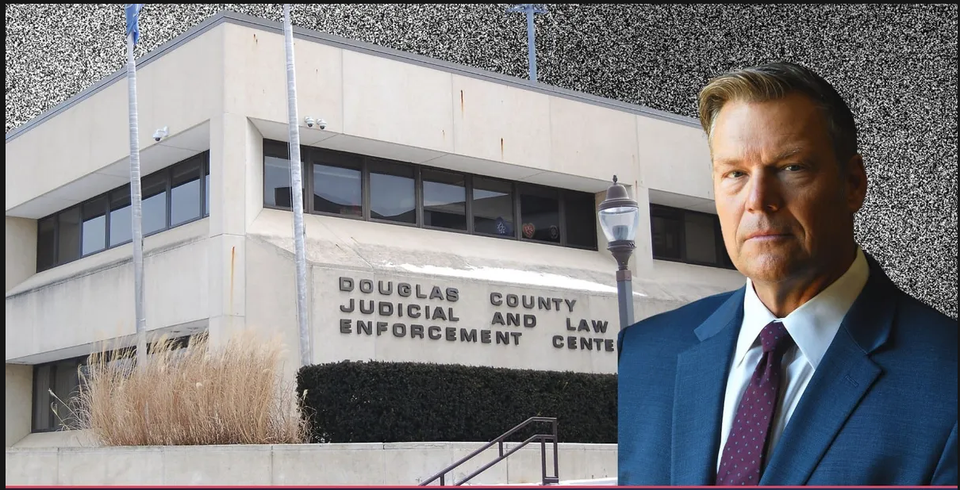
In March, the Kansas District Courts struck down a challenge to the constitutionality of the state's law revoking the legally issued IDs of trans people, forcing replacement with incorrect IDs meant to out them. In his defense of Kansas’ policy, Kansas Attorney General Kris W. Kobach stretched the law to its breaking point.
The hearing was a call for a temporary restraining order, meant to halt the law from being put into effect. The Plaintiffs were two anonymous trans men represented by the ACLU. The Defendants were the State of Kansas (represented by Kansas AG Kobach, the Director of Vehicles, the Kansas Secretary of the Department of Revenue, and the Kansas Secretary of the Department of Administration).
The Court sided with the government's absurd arguments. The judge denied a temporary restraining order that would’ve stopped the law from taking effect. This would’ve granted trans Kansans a reprieve until the constitutional challenge to the law could be heard in full this September.
Kobach argued that trans people wanting accurate identification is forcing compelled speech from the government, and made an indirect argument for 'separate but equal' treatment of trans people, mirroring the very arguments used to justify Segregation.
Worse, Kobach insinuated that breakdowns in social norms, which to him includes the existence of trans people, can be fixed by the state “activat[ing] its traditional police powers” to enforce the state's preferred social norms.
These insights come from a 140 page transcript of the court hearings, obtained by The Needle as part of an open records request into the case. This request was funded by Trans Liberty PAC.
All of the following excerpts are pulled from the transcript directly. The full version can be viewed at the bottom of this article.
Arguing that Accurate ID’s Constitute Compelled Speech
Kobach explicitly argued that trans people wanting correct identification is forcing “compelled speech” on the government.
“That's why our rights in our Bill of Rights both state and federal are negative rights. The government can't do things to me but I cannot force -- our constitution, other than the one positive right of making provision for finance of public schools, we can't force the government to do things we want the government to do, and that's what they're asking for here. They want the government to allow them to use the driver's license as a kind of canvas on which they can paint various aspects of their personality and say certain things.
That's not what the driver's license is. It is a government document issued by the government, owned by the government, controlled by the government, and they are seeking a positive right to compel government action.” - Kansas Attorney General Kris W. Kobach
In other words, he argued that the government has the right to express its views on segments of the population, through the documentation which it issues to said population.
He also said that the people being targeted by the government don’t have the right to influence the government, by saying that “we can’t force the government to do things we want the government to do”. This is an idea that flouts any principle of representative government– such as what is enshrined in the very legal system which AG Kobach is mandated to uphold.
Throughout the hearing, Kobach argued that driver’s licenses and other identification reflecting information about its bearer are a form of speech made by the government, and that a trans person asking for accurate identification is forcing that government to make compelled speech.
Gender Conservatives have long made the argument that an individual being asked to refer to a trans person by their name or their pronouns– something generally afforded to cis people by default– is a form of compelled speech.
Some anti-trans researchers have made similar arguments with regards to medical consensus being in favor of transition medicine– that somehow their personal bias against trans people should be considered scientific– otherwise, they’re being compelled to research in ways that amount to compelled speech.
However, Kobach’s arguments are the first time The Needle is aware of where a government official is extending such arguments regarding referring trans people to the government itself. If taken to be precedent, this line of argumentation would make impossible any legal protections for trans people from the government.
There are many additional problems with this argument, largely centered on reducing trans identity to solely “paint[ing] various aspects of [one’s] personality” and that being trans is somehow a way to “compel government action.”
“...you don't have the right to force the government to speak in certain ways when it speaks in the form of driver's license or when it speaks in the form of birth certificate”
Kansas Attorney General Kris W. Kobach
If you support our coverage, consider subscribing to The Needle as a Platinum tier supporter, at $24 a month- you'll get access to all content AND credited as a supporter! For a limited time, you can get 60% off your first three months!
Arguing That Evidence of Harm Cannot Be Used Against This Law
Kobach also argued that the Courts– and by extension, the Legislature– need no evidence when testing the rationality of this law or its impacts.
“Rational basis review does not require any factual showing. Indeed the U.S. Supreme Court and the Kansas Supreme Court have repeatedly said we, the court, can come up with conceivable reasons, we don't even have to rely on the litigants in the courtroom to provide us with reasons. Anything we can conceive of or they can conceive of that is rational is enough.” - Kansas Attorney General Kris W. Kobach
Kobach argued that the Rational Basis Test be used to evaluate this law. This would mean that in order for the law to stand up in court, the government would only have to prove that there is some governmental interest in keeping that law in place. This is the most lenient possible standard by which it could be reviewed.
This is highly unusual for a law whose effect disproportionately affects trans people, who have historically been subject to discrimination. As Cornell’s Legal Information Institute explains, “The rational basis test is generally used in cases where no fundamental rights or suspect classifications are at issue.”
However, the US Supreme Court has argued as recently as last year in Skrmetti that trans people “do not constitute a suspect class”. As a result, it follows that laws disproportionally affecting them do not constitute discrimination, so long as they are not explicitly listed as the target of the law.
This is something Kobach noted in his arguments in defense of Kansas law when he said that “transgender status is not a suspect class. The Supreme Court of the United States said that in Skrmetti”.
Under the rational basis standard, his claim of not needing evidence of harm is technically correct. In the context of his broader argument, it is insidious.
His argument isn’t wrong, however, it is evil. He insists that the Court does not need to consider evidence of harm done to justify this discriminatory law.
Arguing that the Government Should Not Accept Positive Rights
Kobach stated that trans people wanting identification to the same standard as cis people- identification reflective of their legal and lived status, including in terms of name and sex, is arguing for positive rights.
“I just want to say one more thing on the positive versus negative rights, the plaintiffs' attorney does say one thing on this and his exact words, ‘we're not asking the government to do anything’, end quote.
That's incorrect. They are asking the government to allow certain changes to be made to
driver's licenses and to make those changes at their request and to make changes to birth certificates at their request, and they're asking governments to change the rules governing bathrooms in government buildings contrary to what the government has decided the State legislature wants to do.
These are indeed positive rights, not all of them, but several of the rights they assert [are] positive rights and that is an extraordinary thing.” Kansas Attorney General Kris W. Kobach
In this context, positive rights means any rights which the government is obliged to give to its population. This is in contrast to negative rights, which are things that cannot be done to the population.
His assertion that positive rights are “an extraordinary thing” belies a failure to understand the American legal system as it currently exists. The US has accumulated all sorts of obligations based on positive rights over the years.
These include (but are not limited to) unemployment benefits, social security, all forms of government welfare, and the right to education. These are things that people do not innately have, but that the government is obliged to provision.
That Kobach believes such things are extraordinary demonstrates either that he does not understand how the American legal system works, or that he wishes to see American jurisprudence reverted to a time when the government had little obligations to the betterment of its citizen’s lives.
If you support our coverage, consider subscribing to The Needle as a Platinum tier supporter, at $24 a month- you'll get access to all content AND credited as a supporter! For a limited time, you can get 60% off your first three months!
Claiming that the Government is the Sole Stakeholder in Government Institutions
He also argued that the U.S. and Kansas Constitutions are both rooted in “ancient biblical concepts”. Kobach made that claim as part of an argument that asking for the government to do things for the benefit of its population is a “bold right”.
Quote
“Here's another way to think about it, and I see where you're going, you have a right that you hold as a private individual in this world to walk around freely, to worship, to speak. These are all things that don't require the government to even exist, you just do these things, and some of these are rooted in concepts of natural law, some of these are rooted in ancient biblical concepts but these are things you just have a right to do as a person. The government can't do things to you to stop that.
[SB 244] is different. Driver's licenses don't have to exist as I think you and opposing counsel noted. You noted. Birth certificates don't have to exist. Government buildings like this one don't have to exist and so the government, this is not a situation where the government's not involved, just let me be myself. Plaintiffs are saying in those things that the government has created, we are demanding certain aspects and we want changes.
That's why it's a positive assertion. It's such a bold right they're declaring. I'm not saying positive rights are impossible but they're very rare in constitutions.” Kansas Attorney General Kris W. Kobach
The line of argumentation also implies that the government is the sole stakeholder– the only party that matters– in determining the structure or implementation of things created by the government.
That idea would stand in sharp contrast to the ideas of representational government and government serving its citizens– something the Court itself alluded to.
In the Court’s direct reply to Kobach’s assertion that positive rights are “very rare in constitutions”, which was also one of less than a handful of times where the judge directly challenged one of Kobach’s arguments, the judge stated:
“THE COURT: I just want to be clear, it's the right of a person to exist, it's that Lockean argument, it's the constitutional argument. We enter into a contract with the government and we agree to give up very limited aspects of our freedoms in exchange for greater good, and here I'm trying to fit that in that box as my first step out of the box, I guess.”
Even more of the argument Kobach had made here are incorrect– trans people who changed their IDs to reflect a gender and/or sex transition are demanding what cis people get by default– accurate identification.
Until this February, it was perfectly legal to have the driver’s license be as correct for trans people as it is for cis people. Then the Kansas legislature passed a new law to change that, and retroactively canceled preexisting identification.
Driver’s licenses don’t “have to” exist, but they do exist– because they have become necessary to exist in modern American Society. The way infrastructure, jobs, and other aspects of society are set up in the US means that driver’s licenses are de facto mandatory across most of the country.
Thanks for reading! Join The Needle as a Platinum tier supporter, at $24 a month. For a limited time, you can get 60% off your first three months!
Platinum (and above) members can be credited as a supporter!
Arguing in Favor of Segregation
Kobach also argued that bathrooms aren’t part of government spaces. To make his point, he used an example that could’ve been used in defense of segregation.
“Yes, they've shown that the two individuals have asserted that they suffered this anxiety in that point, but we would say, one, it's not irreparable harm, and they concede in both cases, that there is actually a single use bathroom in the building but it's just inconvenient because it's on a different floor, it's farther away than the bathroom the individual would prefer to use, and as we've noted, the Kansas Supreme Court, has said mere inconvenience does not create an injury much less irreparable injury.” Kansas Attorney General Kris W. Kobach
Here, Kobach says that trans people being separated from the same public bathrooms available to cis people does not constitute an injustice which the government is obliged to undo. This is the very logic behind the "separate but equal” doctrine which undergirded Jim Crow Segregation.
By using “prefer to use” in reference to trans people using the correct bathrooms– according to their actual sex/gender, not what was coercively assigned at birth– Kobach either ignores or refuses to state that a woman– cis or trans, using the men’s room is going to cause more than mere inconvenience. In reality, using a bathroom that doesn’t correspond with your actual, current sex/gender is a near-automatic trigger for harassment and/or assault.
According to one study by Harvard public health researchers, trans kids and youth forced to use the wrong bathroom were 1.3-2.5x more likely to experience sexual assault in their school environment as compared to cis kids in similar environments.
Another report by the Movement Advanced Project, showed that transgender public exclusion laws– often described as “bathroom bans”, ultimately,
“...provide unchecked power to law enforcement officers or even embolden private citizens to take the law into their own hands, leading to aggressive confrontations, interrogations, or demands that other people using a restroom prove their sex. These laws also leave transgender people even more vulnerable to discrimination, harassment, and violence."
Even if there is a gender-neutral bathroom available, there are negative impacts of having the bathroom you’re forced to use due to segregationist policy being on another floor, or on the other side of a building you are in.
Those impacts are well enough known that they are the subject of countless stories about the Jim Crow system. An example of this is a core plot point in Hidden Figures, the film about black women mathematicians at NASA who made early spaceflight possible and got the US to the moon first, all during the Jim Crow system.
However, the impacts aren’t abstract or merely cinematic, they are real life across both the US and UK– and Kobach argued in favor of substantively similar impacts on March 6, this year.
Such impacts include being forced out of work or forced to face corrective action that wouldn’t otherwise happen, invasive questions and harassment (or worse), and having no way to comply that doesn’t actively harm you.
Studies based on 2015 data have shown that 31% or more of trans people avoid eating or drinking in public to delay needing to use a bathroom, and up to 8% have had UTIs or other negative health conditions as a direct impact of these types of trans public exclusion laws.
In the 2015 environment– which was far more favorable to trans people than Kansas is in 2026, the same data showed that 59% of trans people had limited their participation in public to avoid public bathrooms and 12% had been “harassed, attacked, or sexually assaulted in a bathroom” in the year between 2014 and 2015.
This is the stark reality of what Koback is arguing for does mean in practice.
“[The constitution is] rooted in ancient biblical concepts.” Kansas Attorney General Kris W. Kobach
Start subscribing to The Needle as a Gold tier supporter, at $15 a month.
Arguing That Nearly Everyone Is Transphobic
He also argued that all cis people are transphobes. Not just passively transphobic, but rather the most hostile, exclusionist type of transphobe. He explicitly said that 99% of the population doesn’t want trans people in bathrooms.
“But on the other side of the ledger you've got to weigh the injuries of 99 plus of the population that is using and wants to use the bathroom that corresponds to its biological sex, and as the Federal District Court in the District in Kansas in Kansas versus U.S. Department of Education said and recognized factually holding that this does cause significant amount of anxiety to biological females who are forced to share these private spaces with biological males.” Kansas Attorney General Kris W. Kobach
His argument is based on the assumed feelings of cis women in sharing bathrooms with trans women, even though the plaintiffs bringing the case are two trans men.
It’s plainly absurd to assume that every cis person in Kansas wants trans people out of bathrooms entirely. It is even more absurd that he treats that sentiment as being automatic among cis people.
Using Existing Bigotries as Precedent for Transphobic Treatment
Kobach cited the disastrous SCOTUS ruling in Orr to use normalized bigotry– such as xenophobia– in support of his argument against trans people.
“Your Honor, you mentioned the quote from Orr … ‘Displaying passport holders' sex at birth no more offends equal protection principles than displaying their country of birth. In both cases, the government is merely attesting to a historical fact without subjecting anyone to differential treatment’,
Let's suppose I'm from a country that's disfavored in the United States or wherever I'm traveling. I might not like that, that my country of origin is A when the people of this country I'm going to really like country B and they don't like country A. It's just a fact, and it may affect me unequally when entering that port of entry but it's just factual information.” Kansas Attorney General Kris W. Kobach
What’s troubling about this argument is that he’s conflating intolerance based on country of origin– a legally recognized (and prohibited) form of discrimination in the United States- with what he calls “just factual information”.
This entirely misses the point of why accurate documentation is important. As discussed earlier, accurate IDs are essential to being a functional member of society. In the example Kobach uses, existing bigotries are brought to the fore as a result of information about a person’s background which (for better or for worse) are actually accurate to what that person is.
When a racist knowing someone’s country of origin trips up racist attitudes, for example, it becomes more clear why someone would seek to minimize that risk– especially in formal and official contexts.
In that example, someone might use their US driver’s license instead of their passport if the latter would trigger racist treatment.
However, in the case of trans people being denied accurate IDs, existing bigotries are being brought to the fore through the government mandating that IDs reflect old and inaccurate information, rather than current and accurate information.
This new law forces trans people to use documentation that isn’t correct or accurate to their appearance and self with the impact of triggering at best- friction, at worst- discrimination, every time they use their ID.
In this way, government policy is actively contributing to expose trans people to more bigotry than they would otherwise face.
This treatment has been normalized at the federal level already, with disastrous effects. The State Department has already made it impossible to issue accurate passports to trans people.
Kansas’ new law does the same thing for state issued driver’s licenses and birth certificates, forcing trans people into a compromised position with their official documentation and creating friction in contexts where ID is necessary.
In many ways it is worse than the specific example of racism above. Not only do many trans people have ID’s which subject them to bigotry, the government of Kansas is actively editing people’s ID’s so as to make this bigotry more prevalent.
Kobach’s argument naturalizes xenophobia in order to justify transphobia. It is unclear if that was an intended effect of the argument, or a knock-on impact of it.
Act Now! If you have a project, initiative, or other cool thing that helps trans people, join as a Rainbow member to support our coverage to the maximum level AND get the option to potentially have a "shout out" of your project on one of our articles each month.
Arguing that the State Exists to Enforce Social Norms
In addition, Kobach argued that the state can and should compel social norms among its population, especially in the context of allowing trans people to exist publicly.
“THE COURT: Well, that goes to the question I asked earlier, what prevented a man from going into an unoccupied women's restroom because the men's room's [was] full.
Was any crime being committed?
MR. KOBACH: Fascinating question, and we pondered over that as you were asking it. No, there wasn't a criminal law against it. I think it's social norms. People... vast majority of this country's history has said, no, you go into the restroom of your biological sex, and so sometimes there doesn't need to be a law because the way people behave conforms to whatever the social norm is, [most] of the times.” Kansas Attorney General Kris W. Kobach
Kobach specifically said it would be acceptable for the state to “activate its traditional police powers” to “compel people to chew their food” if there was a breakdown in the social norm instructing people to chew food thoroughly before swallowing.
“THE COURT: So when the State acts to create a law, it needs some basis, that level basis determined from the people affected and the interest of the State. If there was nothing that prevented me by itself from entering into a... biological male into a restroom marked women, and now that's changed, are we starting from ground zero? Was there any interests that were affected by that social norm becoming a law?
MR. KOBACH: Let's pick another one. We should all chew our food thoroughly before swallowing; right? That's a social norm. We have self-interest in doing – that's just way people behave, but suddenly people started, you know, go down the internet, you know, swallow things before chewing them. It's conceivable the State might say, well, there's a health, safety, and welfare interest of the State exercising our traditional police powers as they're called to compel people to chew their food thoroughly.” Kansas Attorney General Kris W. Kobach
The specific way he did this, as quoted above, is a clunky means of arguing that trans people simply existing constitutes a breakdown in social norms– a breakdown somehow transmitted by the internet.
What is concerning is not the reflection about the internet’s effect on social norms, but rather that Kobach was willing to make such an absurd claim about police powers and chewing food to defend the segregation and exclusion of trans people.
Mass knowledge about trans people may be facilitated in part by the internet, but that doesn’t mean trans people are an internet fad or somehow ontologically bad– the latter of which is what Kobach argued.
Running The Needle requires your support. Support our proven track record by signing up for a paid membership below. They start at $5 per month.
The Court Went Along With This
In short, AG Kobach is playing a dangerous game in his defense of the exclusion and segregation of trans people– attempting to drag jurisprudence backwards by setting an alarming set of precedents.
What is most concerning is not the arguments per se, but how the Court went along with them, lending credence to Kobach’s anti-trans attacks.
This is evidenced in part by the transcripts itself, in part by the Court’s decision to deny a Temporary Restraining Order, and in part by another Court transcript exclusively reviewed by The Needle which confirms the timeline for the case going forward– the hearing for this case will not start until Sep 29.
From that transcript, the full hearing is scheduled for 3 days and slated to end on Oct 2, nearly 7 months after the March 6 hearing in which these arguments took place.
In other words, the Court was willing to let Kobach’s absurd arguments ensure disenfranchisement for trans people in Kansas for over half a year, even before hearing the full case.
The full transcript of the court proceedings can be read below.
The ACLU is looking for comment from people affected by this law. If you or someone you know is interested in reaching out to the ACLU, details are available HERE.