
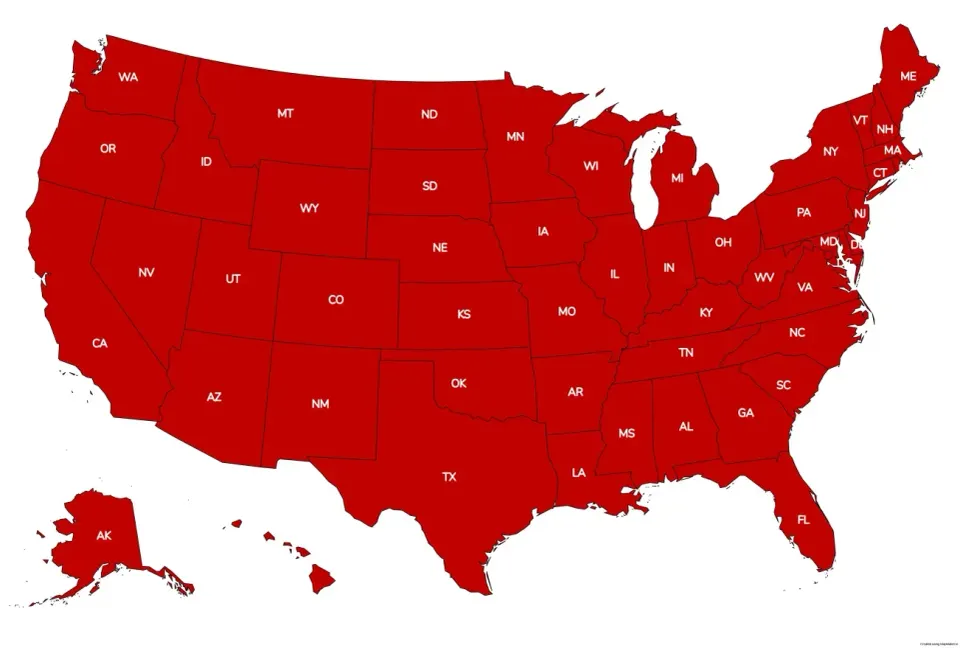
There is a map a lot of us keep bookmarked. It sorts the fifty states from "most protective" to "do not travel," it gets redrawn every few months, and it is genuinely useful for what it measures: how a state's government will treat you; your ID, your healthcare, your right to use a bathroom without a felony charge. The problem is what we do with it. We read a legal-risk map as a safety map. We tell each other to move to the blue state and we exhale, as if a statute could stand between a person and the man who means to kill her.
It can't, and the data says so plainly. When you lay the legislative risk map over the record of who is actually murdered, the two don’t line up. A law predicts how the state behaves toward you. It does not predict how people behave towards you.
I used to be one of the many of us who bookmarked this map, who watched it for changes and for a sense of safety in where I am now. That is no longer my approach, and I hope the data that follows helps explain why.
Before I continue, I need to make this clear: all of this is an undercount.
The Trans Murder Monitoring project, my primary data source for this story, counts confirmed, reported killings. Nothing more. Every number below is below the floor, not a total. By every serious estimate, the real toll runs higher: somewhat higher in the best documented places, and far higher wherever no one is doing the counting. Hold that under everything that follows. When I say a rate, read "at least."
The very first number that should be in your mind and on your post when you share this story: of the 5,320 killings Trans Murder Monitoring has recorded worldwide since 2008, 97% were trans women or transfeminine people. In the United States, that number is 90%. This is a report about trans women. Trans women are the primary targets of transphobic violence, and there’s no honest way to present it otherwise.
Who Is Killed
Nearly every trans person murdered is a trans woman
Trans women are a third of trans people and nine in ten of the dead.
The top two bars are how many of all recorded trans murder victims were trans women. The black bar is how many trans people are trans women. If the violence were indiscriminate, all three would match.
That’s about three times their share of the population worldwide, and 2.7 times in the US. Every recorded case, 2008–2025. Undercounting doesn’t explain a gap this wide.
Writing ‘trans people’ here, flat and unspecified, would be a more-than-small lie through blurring, and that blurring helps the violence stay unrecorded.
Which trans people are killed (2008–2025)
Trans women: 1 in 3 trans people, 9 of 10 victims
Each group’s share of the dead, next to its share of the living.
Trans women are killed at nearly three times their share of the trans population. Trans men and nonbinary people are a smaller share of victims than of the population.
US victims, 2008–2025. Shares rounded to total 100 (actual: 89.5 / 6.7 / 3.8). This is who was killed, not a rate, and the trans men figure reflects bad counting as much as real patterns. See ‘The barely-counted.’
That is not to say that trans men are safe, or that the record sees them clearly. It barely sees them, and that blind spot has its own body count. We'll come back to that. But you have to understand who the violence falls on first, because it falls very unevenly.
Another thing I need to make clear: these city boundaries are based on geographic clustering based on satellite data showing where people actually are. It’s not the static map boundaries, it’s a people, human settlement boundary that is used to calculate these populations and fit the victims into the city and state where they were killed.
The Map
Where trans women are killed, state by state
Killings per 100,000 trans women, per year, 2008–2025. Each square is a state.
The blacked-out states recorded 3 or fewer deaths, meaning there are too few to be statistically meaningful. That’s not a finding about safety; it’s a gap in the record.
Recorded deaths only. Every number here is a floor.

Thanks for reading! Join The Needle as a Platinum tier supporter, at $24 a month. For a limited time, you can get 60% off your first three months!
Platinum (and above) members can be credited as a supporter!
Nearly three times the average, inside one community
Trans women, trans men, and nonbinary people are near-equal thirds of the trans population, roughly 33%, 34%, and 33%, per the Williams Institute. If the killing were indiscriminate, the victims would split evenly as well. It does not come close.
Read that low trans men bar carefully, because it is doing two things at once.
It is telling the truth: transfeminine people are targeted for public, sexualized, misogynistic violence to a degree trans men generally are not.
It is also an undercount, because trans men killed by that violence are frequently logged at the morgue under their sex assigned at birth, and never enter a trans dataset at all. Trans women also face the same risk: not being counted as who they are, and instead being logged by their sex assigned at birth. There is no data on which of us are undercounted more.
Therefore, the 0.20× is real and it could be one of the most severe undercounts in the whole record. Both things are true at once.
The Counting Problem
The fewer killings that get counted, the higher the real toll climbs
428 US trans women are confirmed killed since 2008. What the real number is depends entirely on what share ever gets counted.
Each row simply divides the 428 confirmed deaths by a counting rate. They are not seven competing estimates, they are one arithmetic question asked seven ways: if only this fraction of killings ever gets recorded, how many really happened?
Where the real answer probably sits. Our three-list cross-check (TGEU, HRC, a news scan) found TGEU alone catches about 75% of recent deaths and all three lists together about 91%, but that only measures cases some list caught. A trans woman killed and buried under her birth name never had a chance of entering any list, and no capture-recapture method can see her.
The striped bar is a guess, and we are labelling it as one. A Chao1 estimate on how many outlets reported each case implies counting could run as low as ~12%, which would put the real total near 3,570. That method was built for counting species in a rainforest, not people, and it leans on assumptions this data can’t verify. Treat it as a signal that the count is badly incomplete, not as a number. It is indicative, not actual.
Everything on this chart is a floor. The number 428 is the only exact figure; every other bar is an estimate. What we can say with confidence is the direction of the data: the truth is somewhere above 428, and nobody can tell you exactly where.
Start subscribing to The Needle as a Gold tier supporter, at $15 a month.
The blue states aren’t havens, and the red states aren’t the whole story
Here is the claim that the map I mentioned above invites, tested against the record. If protective legislation brought physical safety, the "most protective" states would show a noticeably lower trans woman homicide rate than the "do not travel" ones. They don't.
No Clear Pattern
A state’s laws don’t correlate to how often trans women are killed
Each dot is a state. The trend line is nearly flat.
Dots are placed by how hostile the state’s laws are and how often trans women are killed there. Same 26 states and same rates as the chart above.
The worst-law states hold the highest rate here (Louisiana, 24.7). The safest states hold the second (Maryland, 23.5) and the lowest (New Jersey, 3.4). Neither group sorts by law.
Every dot is a floor. The 25 states with 3 or fewer deaths are left out, since a rate built on one or two deaths swings too wildly to be statistically meaningful.
The difference between safe states and unsafe states is not easy to predict, and it survives whichever prevalence assumption you use. It is also misleading, because there are no states where 100,000 trans women live. This means that the actual rate of murder is, despite the undercount, more disproportionate than it seems.
Absolute Risk · States
Trans women are killed above the general rate in 21 of 26 states
Killings per 100,000 trans women, per year, adjusted for undercounting. The whisker’s low end is what was actually recorded. The real number is likely higher than the bar, not between the two.
The whisker isn’t an error bar. Its low end is the recorded count. The bar end is that count, but corrected for undercounting. Both are floors: the truth sits above the bar.
Every state the map rates: the 26 with at least 4 recorded deaths. Colors are the state’s Erin Reed legal-risk category; the black bar is the general murder rate.
Louisiana, with some of the worst anti-trans laws in the country, tops the list. Maryland and DC, both far more protective, sit immediately behind it. The colors don’t sort by height: a state’s laws don’t predict its danger.
The states below the line are below on recorded deaths the correction can’t fully repair, not on safety.
You could also look at cities, rather than states, and it paints a soberingly similar picture.
Absolute Risk · Deadliest Cities
In the deadliest US cities, trans women are killed at 10 to 30 times the rate for cis people
The 10 US cities with the highest trans woman death rate. The whisker’s low end is what was actually recorded. The real number is higher than the bar, not between the two.
The whisker isn’t an error bar. Its low end is the recorded count. The bar end is that count corrected for undercounting. Both are floors: the truth sits above the bar.
Killings per 100,000 trans women in each city’s dense core, adjusted for undercounting. Colors are the Erin Reed legal-risk category of the state holding the city. Cities with at least 6 recorded deaths, 2008–2025.
These are mid-sized cities, not the megacities. See the next chart for those. Baltimore sits in one of the safest states, and still ranks 4th.
Trans women are always at risk.
Blue states offer no statistically significant haven; red states show no statistically significant escalation. The pattern isn't there, even as the nuances are.
Absolute Risk · Biggest Cities
Nine of the 10 biggest cities kill trans women above the general rate
The 10 most populous US cities, largest first. The whisker’s low end is what was actually recorded. The real number is likely higher than the bar, not between the two.
The whisker isn’t an error bar. Its low end is the recorded count. The bar end is that count corrected for undercounting. Both are floors: the truth sits above the bar.
Killings per 100,000 trans women in each city’s dense core, adjusted for undercounting. Colors are the Erin Reed legal-risk category of the state holding the city.
Big cities run lower than the deadliest mid-sized ones partly because a huge population dilutes the rate. Nine of the ten still clear the general rate. The exception is Los Angeles, at 5.3, and its 15 recorded deaths across 13.5 million people likely says more about what gets counted in a sprawling city than about safety there. Phoenix, just above the line, rests on 3 deaths; read it as direction, not precision. Washington is the DC urban core, carrying DC’s own Low Risk tier.
San Diego is excluded from this chart simply because there's no data available for San Diego. This reflects an undercounting, not a total safety.
That map is measuring the government, not the danger. And neither is significantly better or worse at recording violence against us.
The data above are despite the undercount. Again, TGEU records only what gets confirmed and reported. It’s hard to predict just how much an individual state undercounts by, so for this story, I’m using the best-guess I can support with the data: that red and blue states undercount to roughly the same degree.
Legal protection isn’t written for every threat
The reason the map fails to accurately represent the risks is almost mechanical. Anti-trans legislation regulates the state's conduct: what a DMV clerk records, what a doctor can prescribe, which bathroom you can legally use. But the violence in this record is overwhelmingly interpersonal. In the Human Rights Campaign's 2024 accounting of fatal anti-trans violence, most victims were killed by someone they knew, such as a partner, a family member, a friend; and nearly 70% were killed with a gun. A bathroom statute doesn’t reach into a living room. A protective ID law does not disarm an abusive boyfriend.
Medical discrimination, criminalization, being forced to stay inside, all of these can and do kill trans people. The problem is, those generally don’t show up in a coroner’s report. The deaths from hostile legislation are therefore silent, unlike the murder data I’m using to write this. The former is data nobody is collecting. Since that data doesn’t exist, I can’t speak to it in the same way.
The data names who is dying with a precision the aggregate rates hide. Of the deaths the HRC has tracked since 2013, 73.7% were Black trans women; more than 84% were Black, Indigenous, or other people of color. Roughly three-quarters were under 35.
Race of the Victims (2008–2025)
Trans women of color are killed at a far higher rate
Where race was recorded, about 9 in 10 trans women killed were women of color.
That’s more than double their share of the population.
Race was recorded for 394 of the 428 victims: 89% women of color, 10% white, 1% another category, hence why the bars total 99%. No trans population race table exists, so US adult population stands in.
Trans Murder Monitoring tells the same story in the U.S.: of trans women victims whose race was recorded, about 89% were Black or Brown. Most were 30 or under. Around half were killed in public.
Who the Victims Are
Nine in ten victims are trans women, and among them, risk isn’t evenly shared
US killings, 2008–2025 (428 trans women). The striped part is what nobody recorded.
Each bar reflects every victim. SWer means sex worker.
Nobody recorded an occupation in 60% of cases, so that 9% is a hard floor.
The average victim is not an abstraction. She is a poor and isolated young Black trans woman, and no legislature's tier changes that profile. It is nearly identical between the protective states and the hostile ones. (And note the phrase "whose race was recorded": race, occupation, and housing status are blank in a large share of cases, so even this portrait is drawn from incomplete data.)
Trans men are not fully spared, they're unseen
This is where we owe trans men more than a footnote. Across the entire global record from 2008-2025, only 117 victims, about 2.2%, are trans men or transmasculine people. In the United States, that amounts to 32 people. The quick temptation is to read that as reassurance. We don’t have data on what number of transmascs killed are recorded as women, vanishing from the count of trans murder victims before anyone thinks to look. What survives in the data is so thin it can barely hold a shape, and it is almost certainly the most severe undercount in the dataset.
The barely-counted: trans men
The record almost can’t see trans men, and that isn’t safety
Of 5,320 killings recorded since 2008, just 117 are trans men or transmasc people.
Where the recorded cases are
The dark sliver is trans men and transmasc people: 117 of 5,320 recorded, 32 of them in the US. Grey is nonbinary and other.
Most are logged under the sex they were assigned at birth and never counted as trans at all. A dataset that can’t see you can’t protect you, and can’t grieve you either.
Keep both facts in the same hand. The violence is aimed, overwhelmingly, at trans women, and the near-silence around trans men in the record is a sign of their erasure. A dataset that can't see you can't protect you, and it can't grieve you either.
Running The Needle requires your support. Support our proven track record by signing up for a paid membership below. They start at $5 per month.
"Move to a blue state" is a misnomer at best, deadly at worst
None of this is an argument against protective laws. Those statutes govern your documents, your medicine, your job, your ability to move through a bureaucracy without being outed, and they are worth fighting for on their own terms. But they protect things other than the fatal violence we face as transfems, and the community does real harm when we sell the first as the second.
"Move to a blue state" is a misnomer at best. We need the laws and the community connections and the resources. One alone won’t save us. If you’re telling a trans woman to move, you better be helping her do it on her terms, and making sure you have people and resources waiting for her on the other side.
At worst, telling a trans woman to move without those things can be deadly: it can pull someone away from the family, the community, and the material footing that were the only things actually keeping her safe, and can set her down, legally protected yet materially and socially alone, in a city that buries trans women at a higher rate than the place she left. Legal safety is not physical safety. The map was never meant to confuse the two. We should stop reading it as if it were.
And through all of it, remember the first caveat: every figure here is the violence that surfaced far enough to be counted. The real number is almost certainly worse than the worst chart in this piece. We are looking at this from below the floor.
A dataset that can't see you can't protect you, and it can't grieve you either.
The Empty Record
Seven states recorded no trans women killed at all, which isn’t the same as none dying
Each bar is how many deaths you’d expect there since 2008. Every one recorded none.
A zero isn’t a lie, and this isn’t proof of a cover-up. These are small states: Wyoming has about 805 trans women, so you’d expect roughly one death in 18 years, and zero is ordinary luck.
Idaho and Nebraska are the only ones where the silence is even mildly notable, at about four expected each. Nothing here is strong evidence of anything, which is the point. The record is too thin in these places to say much at all.
Before reading the red: our own check found anti-trans states record their killings slightly more completely than protective ones, not less. What a blank record proves is only this. Nobody can call these places safe on the strength this evidence.
Expected deaths assume the national corrected rate of 9.17 per 100,000 trans women a year, across 18 years.
"Move somewhere safer" doesn't survive the numbers, if within the US
The instinct behind "move to a blue state" is the same one behind "move abroad". However, moving abroad doesn’t fail in the way that moving to a blue state does. Test the biggest version of it: the entire United States against the entire European Union. Adjusted for population, a trans person in the U.S. is in the best case scenario six times more likely to be murdered than in the EU.
US Cities vs All of Europe; Recorded Deaths Only
Measured the same way, every large US city outpaces the entire EU
Neither side here is corrected for undercounting, unlike every other chart in this piece.
Why no correction: our undercount factor (×2.12) comes from cross-checking three American lists against each other. Europe has no equivalent secondary lists, so its undercount can’t be estimated at all. Applying America’s factor to Europe would assert something we have no evidence for. So both sides stay raw.
That makes this the most conservative comparison in the piece: correcting the US alone would roughly double every blue bar and leave the EU exactly where it is. The gap gets wider, not narrower.
Killings per 100,000 trans women a year. Every bar is a floor, San Diego’s zero included No case fell inside its city core in the record, and a system that misses deaths elsewhere likely misses them there too. Europe’s monitoring is thinner, so some of this gap is counting rather than killing. Still, 428 deaths against 101 is far too big a difference to be a counting artifact.
This list uses the top 9 cities, instead of the top 10 used elsewhere in order to cleanly display the EU data as the tenth city, similar to the other charts.
It isn't a national average hiding behind a few bad places either. Drop down into the individual blue cities people flee to, and the gap only widens: Seattle, New York City, and even Denver each record a higher per-capita trans woman murder rate than the entire EU.
Remember, these are the numbers that are too low, they’re an undercount. We don’t know the full picture. Europe's monitoring is thinner and more fragmented than America's, so some of that gap is in what gets recorded rather than what happens. After all, a single city is not a continent; Denver's figure rests on one death and should be read as directional, not precise. But the broad comparison (478 against 104) is built on numbers far too large to be a counting artifact, and not a single US city we checked has a rate below the EU average. Leaving a red state buys you the solution to the legal problem. It does nothing to address physical safety, or human connection.
I should know. I left the United States for Ireland last year. Ireland is so much safer politically and legally. But if you don’t have the money to access healthcare, and nobody will hire you, it doesn’t stick. I would know; that’s why I’m back in the states. Leaving the US cost me my community in Denver, and I have yet to rebuild that level of connection in Dublin, or anywhere else.
What actually works is easy to take away
If the statute book doesn't lower the killing, what does? The evidence points, unglamorously and with cold irony, at material stability and human connection. Y’know, the two things that society and patriarchy tries to prevent trans women from getting?
The Williams Institute finds that social support, family acceptance, and trans community connectedness are among the strongest protective factors we can measure. Trans people with supportive families had a 5.8% chance of having attempted suicide last year, against 13.1% for those without. Connection is not a nice-to-have here. It is a load-bearing part of a life well lived. Human connection is human survival, especially when the humans in question are trans women.
The flip side is where the violence recruits its victims. HRC's Dismantling a Culture of Violence traces the killings back to precarity: about 1 in 5 trans people have experienced homelessness, roughly 1 in 5 live in poverty, and more than 1 in 10 of the deadly violence victims it tracked were unhoused or housing-insecure when they were killed. Economic instability traps people in unsafe relationships they can't afford to leave, and pushes others into survival sex work. The 2022 U.S. Trans Survey puts hard numbers on it: 34% living in poverty, nearly a third having experienced homelessness in their lifetime, and that being far worse for Black and Indigenous respondents; the same people who show up most in the homicide victim rate.
Community and resources are the only things that reliably protect trans women. But that protection is always tenuous, underfunded, volunteer-run, the first thing cut and the last thing legislated. Add to this my prior academic work on transfeminine precarity, where I found that not only are trans women forced by others into being precarious because we are trans women, but that such precarity is “deep, sharp, and ever present”. What you get is a bleak picture: community is good but not enough. Money and resources are good but not enough. Protective legislatures are good but not enough. We need all three, and then some, just to reach the baseline of being okay.
This is the uncomfortable middle of the finding. The things that work: housing, income, decriminalized sex work, a chosen family that answers the phone, mutual-aid networks like the ones Operation Lifeboat and community-defense groups are trying to build, are exactly the things no legislative session guarantees, and every budget cycle threatens.
Legal protection is easy to pass and easier to photograph. The scaffolding that actually keeps a young Black trans woman alive is neither, which is why it is perpetually one grant, one eviction, one severed relationship from collapsing.
Why People Move Regardless
If moving doesn’t make you safer, why do so many people do it? Because people want to live in a place where people care about them. We want community and human connection.
For many trans women, there are not many ways to find that community. Cis community is generally hostile, and even in its most inclusive iterations, struggles to understand us. There’s always the internet, but that’s its own can of worms.
When people say that Seattle or New York City or wherever else are good places for trans women, they aren't talking about the murder rate. Most people have no idea what the murder rate of their area is, cis or trans.
However, people know whether or not others treat them with respect, since they encounter other people every day. It is this comparative warmth from strangers that makes a place good for trans women, or for anyone else.
That warmth is why I miss Dublin so desperately. The Irish are an acquired taste, to be sure, but they are some of the friendliest people I’ve encountered as a trans woman. I never got misgendered in Ireland, on either side of the colonial border. Dublin and Galway in the Republic were great to me. As was Belfast, still part of the United Kingdom.
The hard data can show you stats on where you will be safe, but they can’t tell you if you’ll feel safe in public. On a gut level, most people value that feeling of safety more than the statistics of safety. Trans women are no exception.
Act Now! If you have a project, initiative, or other cool thing that helps trans people, join as a Rainbow member to support our coverage to the maximum level AND get the option to potentially have a "shout out" of your project on one of our articles each month.
What you can actually do
I refuse to hand you thousands of words on undercounted deaths and then leave. That would violate the first rule of this newsroom and the last thing this data teaches: despair is not analysis. The finding of this report is not "nowhere is safe, give up." The finding is that the things that keep trans women alive are not solely the things governments enact; they are the things people build. Which means they are things you can build. Here is what to build, listed by who you are.
If you're a trans woman
Count your people before you count the statutes. Before any move, across town, across the map, across an ocean, take an honest inventory of what you'd be leaving: the friend who answers at 2 a.m., the clinic that knows your chart, the group chat that notices when you go quiet. Those are load-bearing. I dismantled mine moving to Dublin, and I am still rebuilding. The data is clear about this: connection is not a nice-to-have, it is one of the strongest protective factors we can measure.
If you move, move toward, never just away. A destination is not a plan. A plan is housing you can hold, income that will follow you, and at least one person on the other end who is expecting you. If those aren't in place, the move that solves your legal problems can create the precarity which the homicide data keeps circling. Organizations like Operation Lifeboat exist precisely to do relocation this way: on your terms, with logistics and money behind you.
Treat money as safety equipment. Not because capitalism is your friend, but because precarity is where the violence finds its targets. A savings account as a buffer, a name on a lease, a skill that travels: each one is a tool you can take with you.
Have one person who always knows where you are. Most victims in the HRC record were killed by someone they knew. That is a hard sentence to sit with, and I'm not going to turn it into a checklist of fear. The single, doable version: one trusted person, standing check-ins, and the shared understanding that saying "I'm fine" strangely means you aren’t fine.
If you're a cis ally
Don’t tell people to move unless you're helping them do it. This advice is the cheapest thing in this story. If you are not offering the spare room, the job referral, the deposit, or the drive, what you are offering is the removal of a trans woman from the only scaffolding that was actually holding her. Material help or silence; those are the options. Choose the former.
Be a phone that gets answered. Chosen family is not a role reserved for other trans people. A standing check-in with the trans women in your life goes a long way. Especially with the ones who are young, Black or Brown, and isolated, because that is who this dataset shows we bury most. This help costs you nothing, and is, according to every indicator we have, worth more than your vote.
Fund the scaffolding, not just the fight. Legal orgs are funded, photographed, and thanked. The housing fund, the mutual-aid pot, the volunteer-run relocation network, the things this report identifies as actually protective, are one missed grant from collapse. Ten recurring dollars a month to a trans-led mutual aid group outlasts a hundred one-time surges. If you want a place to start, Lifeboat is one; your local trans-led org is another.
Use your social circle. If you hire people, hire us. If you rent, rent to us. If you give references, give us some. Employment and housing sit upstream of every number in this piece. A landlord has more influence on a potential murder victim than a legislator does.
If you're a journalist, researcher, or funder
Report us as ourselves. Every misgendered police blotter and deadnamed obituary deletes a victim from this record before anyone thinks to count her, or him. The trans masc undercount in this data is not an act of God; it is an editorial choice made one newsroom at a time. A dataset that can't see us can't protect us, and it can't grieve us either. You decide what the dataset sees.
Fund the counting. The blank race fields in the coroner’s report, the missing occupations, the trans men logged under the wrong sex; these are fixable infrastructure problems. Monitoring projects run on volunteer labor and goodwill. If your grantmaking touches LGBTQ+ life at all, data infrastructure belongs in it.
Give unrestricted, multi-year money. The protective scaffolding is perpetually one budget cycle from disappearing. Project grants photograph well; general operating support keeps the lights on between photographs.
If you read this story
Subscribe to The Needle. Seriously. This story took tons of time, labor, and emotion to get right. Our newsroom is a team of 5 people, two working here full time, and none of us get paid enough. That can only change with your support, and we can only continue if we get enough support to do so.
Methodology
The one limitation that matters most. These are all recorded and confirmed cases. Trans Murder Monitoring, HRC, and every source in this piece say the same thing about their own data: it is an undercount, and not a small one. Killings are missed when victims are misgendered in police and press records, when no one reports a murder as a hate crime, when the violence happens where no one is watching, and (for trans men and nonbinary people especially) when the victim is recorded under their sex assigned at birth. Every rate here should be read as ‘at least this much.’ The true toll is somewhere between a little higher and a lot higher, and we cannot tell you exactly where, because we do not know what we don’t know.
Numerator. Victim counts from the TGEU / Transgender Europe and South Asia Trans Murder Monitoring dataset (5,320 records, 2008–2025), placed by coordinates. "Trans women / transfeminine" includes trans woman, travesti, transsexual woman, and TMM-context "trans/transgender." U.S. figures on interpersonal violence and victim demographics are corroborated by the Human Rights Campaign's 2024 fatal-violence report, which counts separately, on its own methodology, since 2013.
Denominators. Population from the U.S. Census Bureau (national, state, and city, Vintage 2024) and Eurostat (EU-27, Jan 2025); the trans population share and the 33/34/33 gender split from the Williams Institute (2025). The relative-risk chart is prevalence-invariant: it compares groups within the trans population, so the choice of trans prevalence cancels out.
Location/Geocoding. Using a traditional list of city boundaries didn't quite work, neither did just using the city or place names in the TMM dataset. This is because the TMM dataset doesn't use one standardized list for all cities and places worldwide. Instead, we used the coordinates (lat/long) of each killing in the TMM dataset and a human settlement model, specificially the GHSL Urban Centre Database R2024A to map each killing to a city. This method also initially lumped DC and the state of Maryland, so we had to use US Census data to reconstruct the exact boundaries of DC proper and rework the geocoding with that change.
Other cautions. Ratios that fall below the general-population homicide rate are an undercount artifact, never evidence of safety. Legal tiers are from a July 2026 snapshot. Laws and federal policies are rapidly changing. Transmasc city ranks past the top few turn on one or two cases. Composition figures describe who was killed, not measured subgroup rates.
The Needle is independent, reader-funded trans journalism — by us, for us. If this is the reporting you want to exist, become a member.
If you or someone you love is in crisis, Trans Lifeline (U.S.) is at 877-565-8860.