

In November, The Needle began investigating McMaster University and its collaboration with anti-trans pseudoscientific research group Society for Evidence Based Gender Medicine (SEGM) on studies claiming that several aspects of trans healthcare are ineffective.
Last month, we obtained internal communications between the two detailing everything SEGM wanted out of anti-trans medical studies, and why it was willing to pay McMaster University over CA$300,000 (US$215,300) to commission studies that suited its political aims.
The Needle found that McMaster gave SEGM, the sponsor of the studies, total editorial control over what was published, and near-total control over the research methods. This gave SEGM veto power over the studies themselves, raising obvious bias concerns. They produced three studies, all of which have been repeatedly cited in restrictions on healthcare for trans people.
While the collaboration has been public for years, the communications between the SEGM and McMaster weren’t disclosed. Thanks to a public records request under Canada’s FIPPA law, The Needle is making much of it public.
All documents are available at the bottom of the article.
The central claim of the studies produced by this collaboration is that the evidence supporting trans healthcare is “low quality”.
This is seen in reporting from Mother Jones, stating that “For self-described skeptics of transgender health care, the words “weak” and “low-quality” do indispensable work. To medical academics like Guyatt, they’re professional terms of art.”
Further, that same report by Mother Jones shows how many other types of medicine are incredibly “low-quality” by the same standards.
“A key argument advanced by opponents of gender-affirming care is that its treatments are only supported by “weak” or “low-quality” evidence, as the SEGM–affiliated reviews and others have found.
The thing is, so are a lot of standard—and essential—medical interventions. Cancer drugs have a notoriously low-quality evidence base, including many FDA-approved treatments. Almost all nutritional guidelines are supported by what Guyatt’s system labels poor evidence. About five million youth have asthma in the United States—yet the evidence for medical guidelines for pediatric asthma care is regularly rated “poor” or “weak,” as are many of the treatments, which have indisputably saved countless lives.”
 Artemis T. Douglas
In an email between the two parties as they were negotiating their collaboration, a redacted SEGM email tells McMaster researcher Romina Brignardello-Petersen that “[w]e are eager to start collaborating ASAP”.
They then explained what they wanted out of the studies: “Our priorities are shifting and we may want to move on straight to [systematic reviews] of key interventions of Social Transition, Puberty Blockers, Cross-Sex Hormones, Non-Genital Surgeries, Genital Surgeries for [those under 26.]”
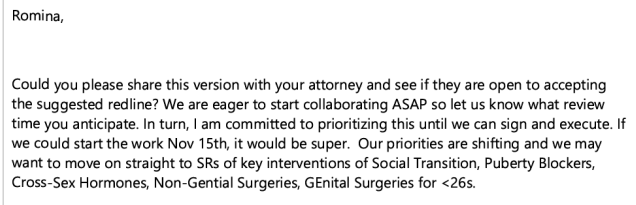
It is notable that SEGM described these as its priorities in 2021, years before these issues were being discussed by mainstream anti-trans figures. At this time, not even most Republican controlled states had banned transition care for minors or trans participation in school sports.

Thanks for reading! Join The Needle as a Platinum tier supporter, at $24 a month.
Platinum (and above) members can be publicly credited as a supporter!
That SEGM said that their “priorities [were] shifting” shows its longstanding interest in pushing the scope of anti-trans medical arguments, and suggests that the scope of these proposed studies had been narrower.
Secondly, the email shows that SEGM played a major role in determining the scope of the studies. The collaboration resulted in three completed systematic reviews: one on Mastectomies for people under 26, one for HRT for those under 26, and one for puberty blockers, where the raised limit is not relevant. These reviews were released in 2024 and 2025.
Since they were released, the studies have been cited as the basis of new medical policies. Earlier this year, the American Society of Plastic Surgeons advised against performing mastectomies on anyone under 19, citing a McMaster review as a key source of evidence.
The rest of the documents cover the technical details of their collaboration, including the contract signed between them.
In Appendix A of their contract, McMaster hands over editorial control to SEGM.
Quote:
The research team will conduct systematic reviews of the literature and any other evidence
syntheses agreed between the groups using the highest possible methodological standards, in full consideration of the needs of SEGM and the nature of the evidence available in their contexts of interest.
These include, but are not limited to, systematic reviews, scoping reviews, and overviews of reviews. It does not include, however, the development of practice guidelines.
The research team will collaborate with SEGM to establish the objective, type of evidence synthesis scope, and eligibility criteria of the evidence to include in such syntheses, and will provide expertise and advise to make these choices.
The research team will update SEGM about their progress on a biweekly or monthly schedule as needed.
Whenever the research team needs to use innovative methodological approaches to conduct any stages of the evidence syntheses, they will obtain approval from SEGM before proceeding.
In short, this gave SEGM near-total power over the studies conducted through this collaboration by giving them veto power over the research methods.
In other words, there was no editorial firewall between sponsorship and the published findings. This raises concerns about the integrity of the research
According to an academic study of systematic reviews, they are used by industry-sponsored research in ways that create a “systemic” risk of bias.
Industry-sponsored studies tend to be biased in favor of the sponsor’s products. Several studies have explored this issue, documenting how the funding source can influence the design, conduct, and publication of research. Although more difficult to define, sponsorship can also influence the research agenda, namely the initial step in conducting research, during which the research questions are chosen and framed.
That same study also says that:
“Biases in research are systematic errors that restrict the validity of a study and can threaten the credibility of the evidence on which decisions are based.”
This can be seen in the terms of the contract. When discussing the completed work, it says that:
[T]he deliverables will be those agreed upon [by] SEGM and the research team. These include written reports to SEGM, and manuscript[s] for publications. We anticipate that, on average, we will produce 2-3 manuscript[s] for publication (systematic reviews of the literature) per year.
This is perhaps unsurprising given the stated aims of SEGM, but prompts questions about why McMaster would agree to participate in research it didn’t control, and where results that SEGM did not approve of could be discarded.
SEGM’s tax filings show that it paid for open access publication of nine manuscripts in 2021, 11 in 2022, and 8 in 2023. The number is not disclosed for 2024. The tax filings for 2025 are not publicly available.
It is important to note that McMaster’s partnership with SEGM is not the only source of systematic reviews commissioned by SEGM.
SEGM commissioned five studies in 2023, and five more in 2024. It did not disclose how many studies it funded in 2021 or 2022.
Just as earlier studies on youth medical transition were used to undermine the medical consensus on puberty blockers and other forms of HRT, so too are these latest studies being used to undermine the consensus on HRT and mastectomies for adults. This can be seen in the calls of influential far-right figures for banning medical transition for adults, a limited version of which is now in the platform of the Texas Republican Party.
The anti-trans studies of today are informing the proposed anti-trans policies of tomorrow.
All documents which The Needle obtained through our records request can be found below:
Remember that most studies refute the conclusions that SEGM tries so hard to push into the public sphere.