
The lived impacts of Kobach’s varied crusades and the damage they cause to living, breathing humans don’t dissappear with a new election.
On Nov. 3, Kris Kobach lost re-election as Attorney General to a Democrat, Chris Mann. This was a race that hasn’t been called even after the election due to heavy amounts of mail-in ballots but Mann is currently projected as the winner. Kris Kobach is the AG that oversaw and “urged” the passage of what became SB 244.
SB 244 is the landmark anti-trans legislation that made trans Kansans undocumented in their own country overnight, authorized private bounties against trans people using the correct restroom, and stands as one of the worst anti-trans laws in effect nationwide.
Now, new records show more of the build-up to SB 244 as built by Kobach’s office- and Kobach himself.
Editor’s Note: Discussion of the records is at the end of this article, and the records themselves are embedded at the bottom.
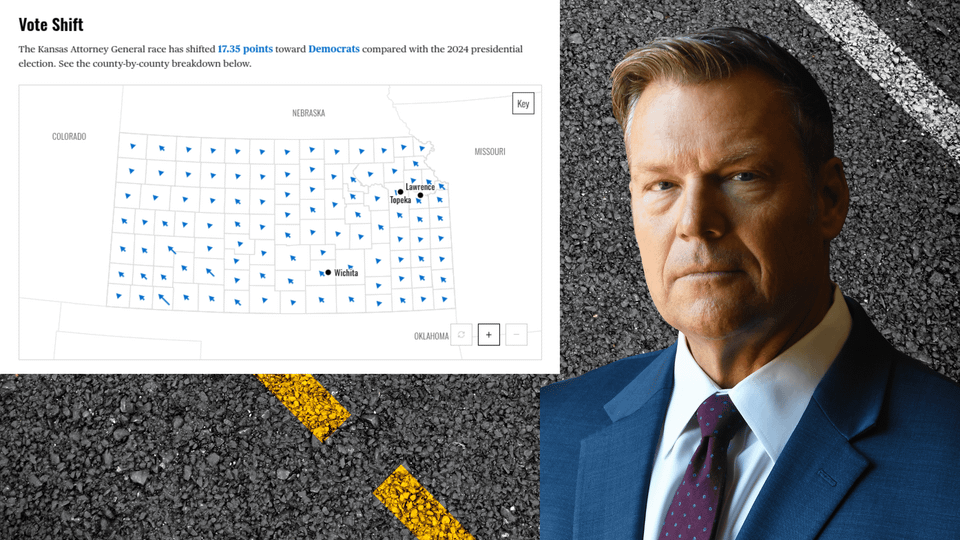
According to a breakdown by NBC News, every county in Kansas shifted towards the Democratic party in 2026, as compared to 2024. The smallest shift was D+5.2, the largest was D+49.77, and the statewide shift was D+17.35.
Kris Kobach is a longtime architect of right-wing regression. In 2011, the Southern Poverty Law Center wrote a report titled When Mr. Kobach Comes to Town: Nativist Laws and the Communities They Damage. That report shows how Kobach spent his early career building right-wing immigration and border security policies post-9/11. According to SPLC,
"Kris Kobach has been a creature of the political right for as long as a public record exists.”
Kobach’s good at making changes towards right-wing policy that don’t quite stick, according to the same report.
“Kobach also takes credit for leading the DOJ’s much-criticized 2002 reform of the immigration court system, which cut the number of Board of Immigration Appeals (BIA) judges from 19 to 11— a change described as a “streamlining” of the system by some but criticized by others as a “purge” of pro-immigrant judges that compromised the system’s ability to find facts. Within four years, the DOJ, seeing that the BIA reform was clogging the courts and resulting in poor decisions, effectively reversed Kobach’s moves, partly by boosting the number of judges.”
Going back further, Kobach championed a city law that was extremely harsh against immigrants in the small town of Hazleton, Pa.- it was also the first of a wave of similar ordinances. This law ultimately didn’t survive constitutionality challenges.
"In 2006, Kobach and Hethmon got involved in the town that hard-line Mayor Lou Barletta had promised to make “the toughest place on illegal immigrants in America.” Barletta’s proposed ordinance, passed that July, allowed the city to deny business permits to employers who hired illegal immigrants, mandated fines of up to $1,000 for leasing to them, and made English the official language.
Civil rights groups sued the town the next month. In court, the city claimed that undocumented immigrants had brought crime and other ills, but its own data did not reflect that. There reportedly were 8,575 felonies in Hazleton between 2000 and 2007; only 20, or about one fifth of 1%, were linked to undocumented immigrants. Faced with evidence that there was no immigrant-linked crime wave or overcrowded schools and hospitals, Barletta said, “The people in my city don’t need numbers.” Apparently, that kind of reasoning wasn’t good enough for the court system. In July 2007, after Hethmon and Kobach had retooled the law to try to withstand the legal challenge, a federal judge found the law unconstitutional.”
Then, in 2010,
“The culmination of Kobach’s work to date came on April 23, 2010, when Arizona Gov. Jan Brewer signed what is certainly the harshest anti-illegal immigration measure in memory. The S.B. 1070 law, largely drafted by Kobach, makes it a crime for an immigrant to be in Arizona without carrying immigration documents. It also authorizes police to check the status of anyone detained for other reasons if they have a “reasonable suspicion” that he or she is not in the country legally. The law’s stated purpose is “attrition through enforcement.””
In 2012, the U.S. Supreme Court struck down key provisions of that law, which had been drafted by Kobach- and defended by Kobach as outside consultant to the tune of $1 million.
According to NPR in Kansas City,
“Kobach previously pushed a law requiring Kansans to prove their citizenship to register to vote when he was secretary of state. That law was later blocked by the courts and his efforts to prove widespread voter fraud didn't pan out.”
On Jan. 13 of this year, Kobach wrote formal testimony in favor of HB 2426 which would’ve amended the “Women’s Bill of Rights” in Kansas.
That testimony opened with,
“This bill is very short, and its purpose is very simple—to correct an error committed by the Kansas Court of Appeals, and to restore the Legislature’s intent. The Court of Appeals defeated the legislative intent of SB 180, also known as the Women’s Bill of Rights, which stated that in Kansas law and in Kansas governmental documents “sex” means biological sex at birth. The Court of Appeals twisted the meaning of SB 180 so that it does essentially nothing.
In State of Kansas ex rel. Kobach v. Harper, my office represented the state in enforcing Senate Bill 180. The case involved whether the Kansas Department of Revenue could continue allowing changes to gender markers on driver's licenses that contradicted an individual’s biological sex at birth. I personally argued the case in the Shawnee County District Court, which ruled correctly and held that the Department was violating the law when it continued to allow changes to driver’s licenses. The plain language of the bill was not difficult to discern.”
The closing paragraph reads,
“I urge the passage of this bill. This is an example of the clean-up work that legislatures must do when courts try to twist the meaning of the law. But it is necessary work to ensure that the people’s representatives remain in control of what Kansas law is.”
Yet, for all his bluster, these provisions which were rolled into SB 244 after HB 2426 died in the legislature before leaving committee, are currently subject to constitutional challenges under the Kansas constitution.
Only time will tell if SB 244 is yet another Kobach-championed bill that can’t hold up to actual constitutional scrutiny by the judiciary.
However, Kobach is likely going to lose his position as AG and his state shifted their preference for his seat by almost 18 points towards Democrats.
It’s safe to say that the anti-trans crusade is wearing thin as electoral strategy. Yet, the damage remains in its wake.
Trans Kansans can no longer have accurate identification because the government in Kansas decided it knew who they were and that it was going to refuse to acknowledge that trans people can and do change their sex.
Kobach himself seems to deny this reality. Another piece of his testimony in favor of HB 2426 was,
“Our experience in defending the state in Harper underscores the real-world implications
• Law enforcement relies on accurate identification documents for public safety. Inconsistent gender markers on driver’s licenses can complicate interactions during traffic stops, in the execution of arrest warrants, and in correctional facilities, where correct biological sex information is essential.
• Vital statistics, used for public health and demographic data, must be grounded in objective biology and history to maintain reliability. This bill ensures that Kansas collects and maintains data identifying individuals as male or female at birth without compromising factual accuracy.”
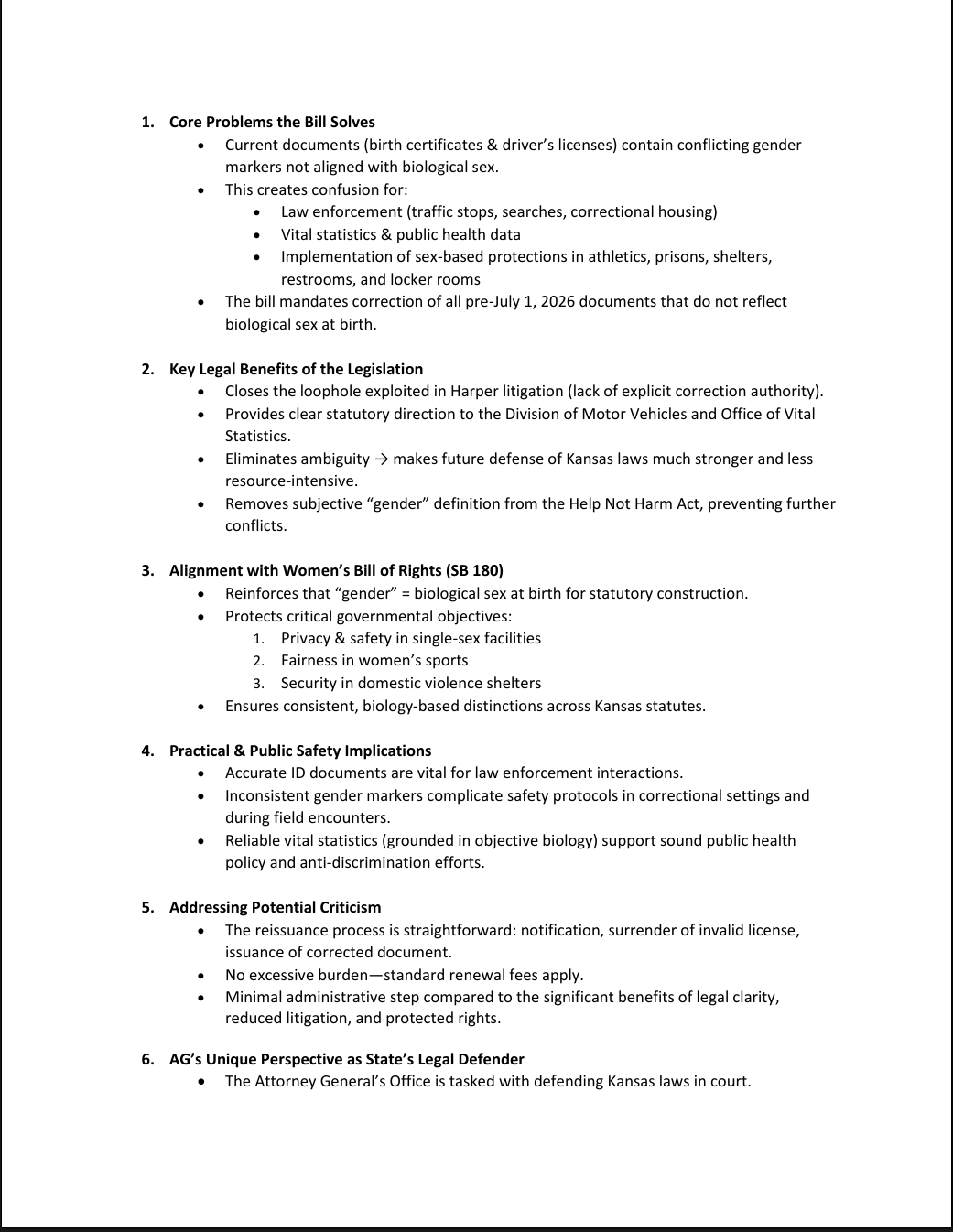
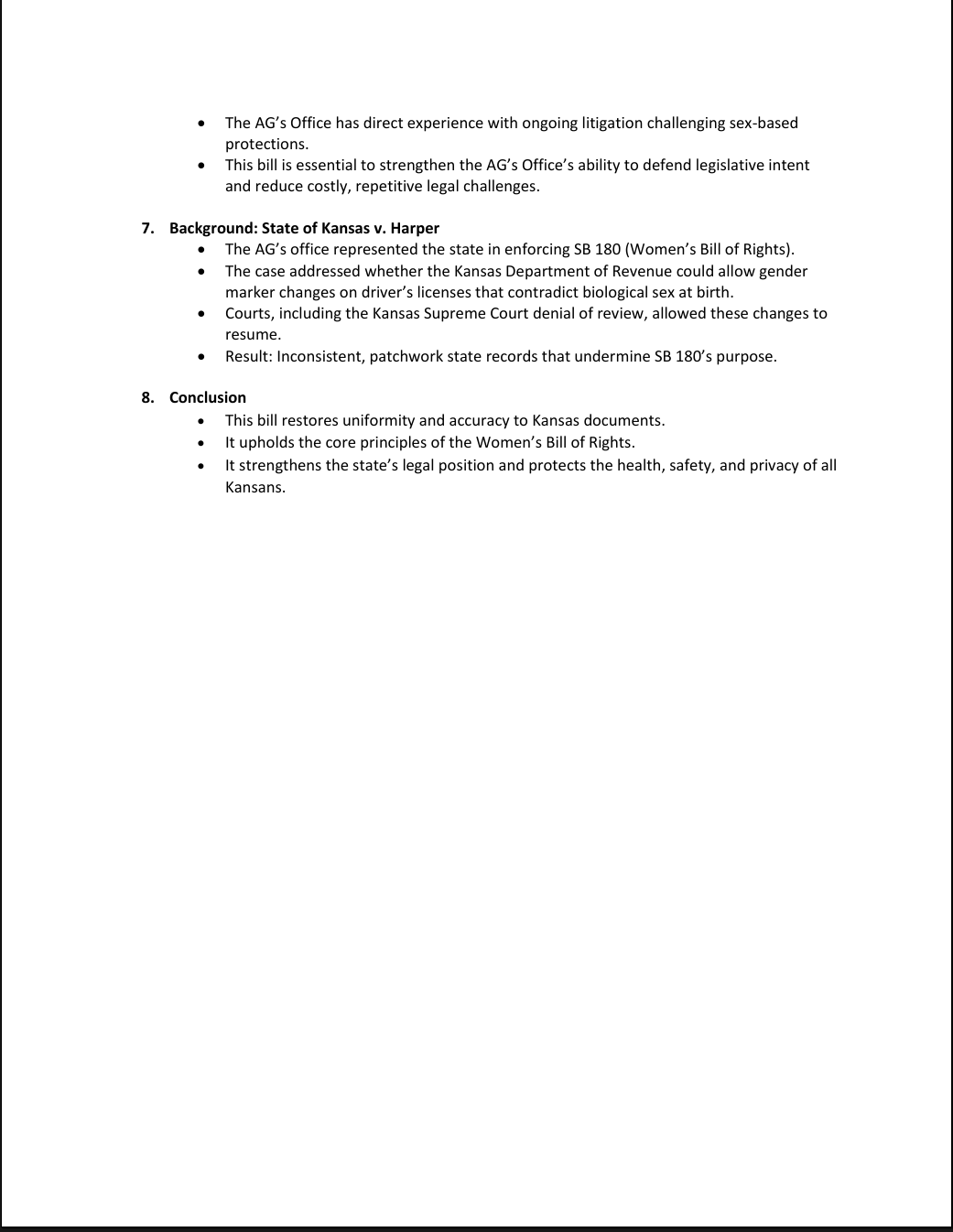
Another document released to The Needle as part of the same KORA request shows the talking points drafted around the “DL Bill”, or driver’s license bill, which ultimately became SB 244. An email associated with that memo drafted by Kobach’s office states, “Proposed talking points from AG’s office on drivers license bill. For legislators, we’d obviously eliminate sections 6 and 7”.
Mr. Kobach, objectively, most trans women have breasts grown the same exact way as cis women and many trans men have beards grown the same way as cis men. Those are just one sex trait that our transition medicine changes, among many, many, others.