
This article is a republication from Rewire News Group. The original release can be found here.

Lagos has legendary dance parties. But in a country that outlaws same-sex relationships, it takes an army of safety workers to keep LGBTQ+ raves safe and private.

Cast your mind back to May 2026. That’s where this story begins, in Lagos, Nigeria. It’s half past 3 in the morning at Group Therapy, one of the biggest rave series in the country.
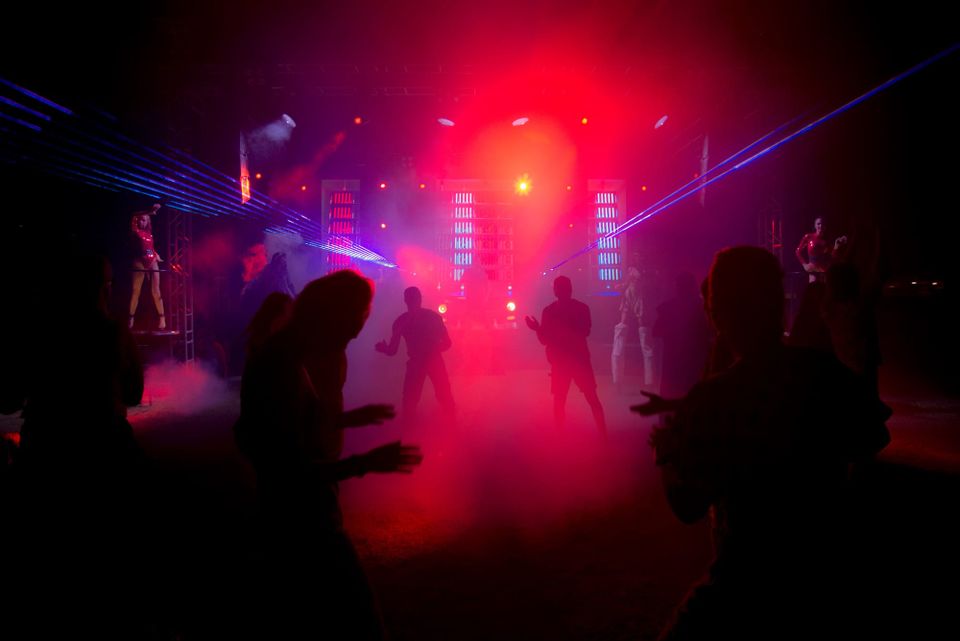
The atrium is heaving with the oontz of Afro house, a hypnotic strain of house music built on deep bass and African percussion. The rave’s signature green strobes slice across sweating faces and bodies packed shoulder to shoulder. Fruity vape smoke hangs in the heat.
Martins Chukwudera, a community organizer and advocate for queer rights, is moving nearly unnoticed through the crowd, though he’s wearing a neon-colored reflective vest and watching the room. Chukwudera, who uses he and they pronouns and who asked to withhold his last name for safety reasons, is a welfare volunteer at Lagos raves.
This is what they remember about their fourth time patrolling a Group Therapy event. A scream punctuates the music: Two women and a man are shouting at one another. Chukwudera hurries over.
“Hi, what’s going on?” Chukwudera recalls asking. “What happened?”
One woman replies: “Oh my God, yes, thank you. You are on the welfare team, right?”
“Yes, I am. What’s going on?”
“He harassed my friend. He groped her! I have it on video.”
A queer enclave goes mainstream
Now come back to the present, please—to this moment, this article.
It will tell Chukwudera’s story, shadowing him for 48 breathless hours as he works to keep queer revelers and women safe at raves across Lagos. The early parts of this account are based on the recollections Chukwudera shared in an interview with Rewire News Group.
Where possible, they were verified through the smart-phone footage that’s become so ubiquitous whenever there’s a public melee.
Take the Group Therapy incident, for example. Several distraught onlookers captured that dispute and posted clips online. It quickly went viral in Nigeria. That’s how RNG first caught wind of Chukwudera and began exploring the role that he and other “welfare volunteers” play in the city’s club culture.
Think of welfare brigades as in-house peacekeepers. Sometimes, they are employees of the venue, but often—as in Chukwudera’s case—they are contract workers.
Welfare workers usually monitor parties in teams, and they may be on their feet for six to eight hours straight. They move through packed venues while everyone else is dancing away the stress of living and working alongside more than 20 million other people in the metropolitan city of Lagos. They keep their eyes peeled for attendees that look uncomfortable, dehydrated or any hubbub happening.
Lagos raves did not always need people in reflective vests watching for the inebriated or for others who might need help.
The rave scene was built around smaller, queer-coded gatherings following the passage of the Same-Sex Marriage (Prohibition) Act in 2013, which went beyond marriage to outlaw gay organizations and public displays of “same-sex amorous relationships.” Law-breakers may be punished with up to 14 years in prison.
“Raves have always been a queer thing,” raver Feyikemi Samantha Adekola, 26, told RNG. “They give people a space where they feel safe to wear whatever they want and be whoever they want.”
Police had long broken up Lagos parties. But after the anti-gay law, rave raids became more prominent, and led to the arrests and public humiliation of men presumed to be gay.
In October 2020, an explosive protest movement against police brutality deepened many young Nigerians’ distrust of authority. A few years later, there was a mushrooming of electronic dance music in Nigeria.
The once tight-knit rave scene began to grow more mainstream. That caused some friction between straight ravers and the queer community.
“The commercialization of raves has opened the door to so many straight homophobes,” said Adekola, a frequent flyer at Lagos’ raves who said she’d watched the scene evolve before her eyes.
And if the police wouldn’t protect queer ravers, they would have to protect themselves.
“I’m here for a good time,” Chukwudera told RNG of his dual role as a raver and a welfare worker. “But can I get home after a good time?”
We put the sexed back in bed
What do wellness teams do?
“Forming systems within ourselves is definitely a tradition we [queer people] have long practiced,” Olawale Shittu, executive director of the youth empowerment group TIMED Foundation for Development and Empowerment Nigeria, told RNG.
Today, welfare teams have become something of a cottage industry in Lagos. Before the curtains open at any celebration, welfare workers are educated on the geography of the venue—the entrance, exits, and bar setup.
Once the music starts, they disperse. They keep their eyes peeled for someone who looks unwell, has had too much to drink, or appears tense and uncomfortable.
Long-time ravers debate how commercial the welfare business has become. But many have deemed the teams necessary. At Ilé Ijó (which translates to House of Dance, in Yoruba), another big Lagos rave collective, founder Abiodun Oladokun said the party had to institute welfare workers as the crowds grew.
“We went from being a few guys gathering for the love of the music to a wider community of people from all facets of life trying to be a part of what we do, and the need to keep everyone safe and properly looked after during the night became unavoidable,” Oladokun said.
When RNG attended a rave called V7 to see these queer safety plans in action, though, there was no need for a welfare team to resolve a mild dust-up between dancers.
This party took place on Lagos’ Country Beach in October 2026. The Atlantic Ocean was crashing against the shore while the speakers pumped bass through the sand. People in Speedos and fairy wings danced with abandon. The sound of the sea and the sound system merged somewhere between the crowd and the water.
Once, a queer person pressed his body up against two straight men and was promptly shut down. One of the dancing men, who went by Sol (not his real name), later observed that for the first time, he felt how women must feel with men at parties: It was his first time getting grinded on.
But he didn’t respond with any adamancy or rudeness to the advance. The person just apologized and moved away.
The conflict at Group Therapy did not end so easily.
May 2026: Group Therapy, 4 a.m.
Shortly before dawn, the music at Group Therapy is so loud that the two women and the one man who are fighting can’t hear one another properly. Chukwudera asks them to take the argument outside.
The man refuses.
“Someone said you harassed her right here, right now,” Chukwudera recalls telling him. “We need to go have a conversation about this.”
He still won’t move.
A tall guard with “security” emblazoned across his shirt arrives and tells the man to leave. Another refusal. The guard calls over a uniformed armed officer.
Still, the man stays put.
“Do you know who I am?” he demands, as if his social status will protect him.
The woman who accused the man of harassing her is still right there, watching while the people who are supposed to remove the man stand around.
Chukwudera finds the scene absurd.
“I was like, ‘We’re not supposed to have a conversation at this point,’” they later told Rewire News Group.
Around 4 a.m., perhaps a half hour after the initial report, Chukwudera intervenes physically and forces the man out of the club.
A solution by queer Nigerians, for queer Nigerians
As queer nightlife becomes more commercial and draws in crowds less comfortable with queer expression, Shittu said, self-protection becomes more urgent.
“Solidarity,” he said, is no longer just a matter of “identity.” These days, it requires “providing solutions for the problems we’re facing.”
The United States has similar kinds of self-protection. In cities across the U.S., women walk home in groups after a night out. In highly-policed neighborhoods, neighbors alert one another when law enforcement comes around.
And although more legal protections for queer Americans exist on paper, anti-LGBTQ+ discrimination is common in the U.S. In a 2024 survey done by the Center for American Progress, 36 percent of queer adults reported experiencing discrimination in the previous year, at work, in their housing options, and in public spaces.
In the U.S., the law protects you officially, though not always in practice. In Nigeria, there’s no legal protection. And every day, or on any given night of busting “Moves Like Jagger,” things can go awry.
What feels new about Lagos’ welfare brigades is how homegrown the solutions are: These are needs identified by queer Nigerians, answered by queer Nigerians, and designed for queer Nigerians.
When RNG attended Monochroma, another prominent rave, the party’s focus on security was clear. Monochroma refers to its welfare workers as marshalls, and these marshalls handle club access, survey the perimeter, and prevent any physical altercation.
The Monochroma team showed prescience for trouble before it happens: noticing distress and stepping in on harassment or consent-related issues to defuse situations before they turned into confrontations. That is what wellness workers are trained to do.
“A typical venue reads a person in distress as a liability to usher out,” said Mariam Sule, who handles communications for Monochroma, in an email to RNG. “We wanted it to read as a cue to step in.”
Both Ilé Ijó and Monochroma recruit their welfare volunteers mostly from within their own communities.
Many of Monochroma’s marshalls are “dancers, attendees, and community members first,” Sule said. They’re assimilated into the party—but ready to spring into action when needed.
That’s how Chukwudera got into this business. They don’t run a security company: They and a small circle of queer friends started approaching the organizers of raves they historically attended—including Group Therapy, Monochroma, and Ilé Ijó—and offering to help create a better experience for marginalized partiers.
At Monochroma’s August 2026 show, RNG witnessed people with welfare lanyards around their necks enjoying the music.
May 2026: The next night, at the Ilé Ijó rave
Chukwudera does get home safe from Group Therapy at around 5 a.m. on May 9, 2026. They sleep for eight hours, and wake up to missed calls and messages about the night before.
On X, two videos of the previous night’s fight have already gotten thousands of impressions. One appears to show the initial assault against the woman. Another shows Chukwudera slapping and kicking the alleged harasser during the removal.
Later, Chukwudera would say that he wished Group Therapy had done more follow-up after the viral May groping incident. He wanted a debrief.
In an emailed statement to RNG, Group Therapy disagreed with that characterization.
“The attendee was immediately removed from the event with the help of our welfare team and placed on our no-entry list. Photos and video of the offender, taken by our team member, were also circulated widely to the community—the media footprint remains online,” the organization said.
But on the morning after the rave, Chukwudera has no time to dwell. There’s another rave to work. By 11 p.m., Chukwudera is back in their reflective vest, this time at Ilé Ijó.
There, he recalls, multiple ravers have accused a security guard of groping them. Male ravers say he grabbed their genitals. Women say he would pretend to search them and then touch their breasts and genitals.
Just hours earlier, Chukwudera had watched security struggle to remove a man accused of harassment. Now, at a different rave, a man hired to provide security was the one accused of harassment.
Chukwudera sees one woman confronting the security guard furiously. At one point, she tries to rally a crowd to beat him up.
Oladokun—who is the rave’s co-founder as well as both a DJ and lawyer—arrives. In Chukwudera’s telling, Oladokun wanted to solve the problem through official channels: The guard was hired through a security company; they could report him to his employer.
“We know these people,” Chukwudera remembers Oladokun telling the woman. “We can find this guy [the security guard] afterwards.”
As promised, Chukwadera said Oladokun did check in with them the next day about the allegations against the security guard.
Not just a ‘better bouncer’
This, safety workers and rave operators told RNG, is why welfare workers can’t simply be a better kind of bouncer.
A Nigerian bouncer’s job is simple: They monitor the club entrance to make sure people without tickets don’t get into the club. Welfare teams work on the dance floor. They’re trained to understand the nuances of the guests and the type of safety required in a queer space.
Safety at these events breathes in the smaller rules. Ask consent before dancing with someone. Don’t record anyone—especially queer individuals—dancing or making out. Be thoughtful about where your gaze lands.
“You can look, but then look away,” Adekola, the frequent raver, said. “Why are you staring piercingly?”
Bouncers are often beefy fellows. Welfare workers, in contrast, are frequently women. Oladokun said that he believes people feel more comfortable approaching women.
“A woman in a green vest reads as ‘safe’ in a way that a male bouncer simply doesn’t,” he said.
Adekola agreed.
“Women are always looking out for queer people at these raves, and they look out for us [women] too,” she told RNG.
As Sule described, women and femmes are often socialized to recognize discomfort and mediate tension. These are key qualifications for people trying to protect ravers in the dark, chaotic revelry of strobe lights and illicit queer joy.
Misturah Sanni, 26, handles welfare for Nigerian raves like Palmwine Haus and Healing in Saturn.
She told Rewire that she sends her team, donned in reflective jackets, “to shadow people I think might be in danger, or to check and make sure what she sees is consensual.”
Sanni, a lawyer in Lagos, remembered being onstage at a rave early in the night when a woman began rubbing against her and touching her body without her consent.
“She said something along the lines of liking my dress or my body,” Sanni told RNG.
She found the encounter “jarring” but did not inform the welfare workers. Later that night, she learned that the woman had also inappropriately touched other dancers.
Welfare teams are paid for their labor, but rates vary widely. Group Therapy paid Chukwudera a stipend of 25,000 Naira—around $19 (the monthly minimum wage in Nigeria is $55). The organization called its compensation of welfare teams “in line with or above” comparable paid roles in the rave scene.
But, Chukwudera said, “Some are paying triple, double that.”
The disparity points to a growing gulf: Many ravers now expect welfare workers at these events. The standards, however, for this service—what it should look like, what it should cost, or what proper follow-up should be—is still unclear.
Protection at raves is a new and evolving trade, and Chukwudera sees each party as an opportunity to keep learning. He thinks every rave should leave behind more than empty cups and a dismantled stage—it should spur a conversation about “what can we do better?”
Was the ambulance parked in the right place? Did people know where to find it? Was there enough water? Could a trans woman safely use a toilet meant for women?
“We can’t have a one-size-fits-all safety plan,” he concluded.
May 2026: Chukwudera’s home, 6 a.m.
By dawn of his second day working, Chukwudera is completely wiped out.
It has been a wild 48 hours. A scream, throwing out an assailant, going viral for it. Watching the very people meant to provide security become the problem themselves.
Chukwudera sighs. Carrying what Lagos’ queer nightlife needed on their shoulders, they finally take off the reflective vest, and go to sleep.