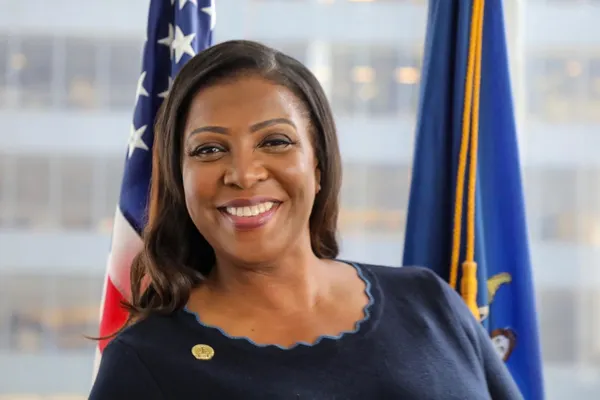

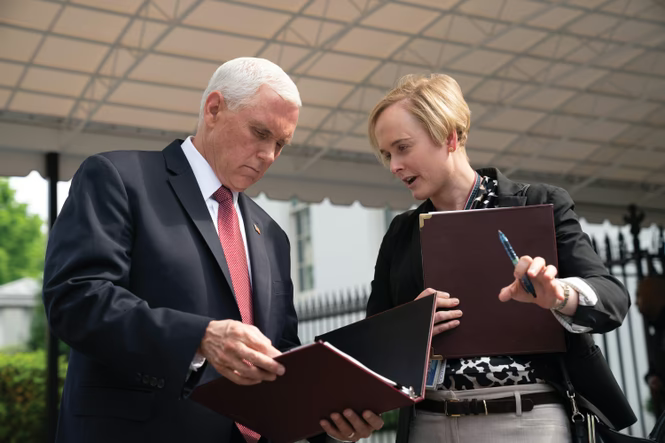
For the past week, media outlets have been obsessed with Julia Curlee, the trans CIA analyst fired by the Trump White House for being trans. She worked openly while reporting to Vice President Mike Pence, and previously said that “trans kids should know, [the] CIA is always recruiting.”
She was, by every definition, a typical All-American success story. Coming from an immigrant background, she was told that if you “Work hard, [and] don’t complain”, then “the country will take care of you.” She followed this mantra to great personal success… until her being trans disqualified her.
The reaction she has gotten from the general public has been overwhelmingly positive. The United States is full of people, cis and trans, who believe in the ideas of “Service before politics” and “Country before self.” Many of them saw Curlee serve her country with distinction, get canned for being trans and open, and (rightfully) saw this as an injustice.
The reactions from trans people themselves, the people group Curlee was fired for belonging to, have ranged from showing mixed feelings to outright mocking her. To many trans people, this is not a sad story, but one of someone who worked for the leopards eating people’s faces having their face eaten by a leopard. In short, they feel she had it coming.
Why the disconnect? A large and growing number of trans people are less patriotic than previous generations, in no small part because those patriotic Americans have now spent years trying to remove us from public life. As a result, many see those still serving the US Federal Government and related industries as somewhere between alien and traitorous.
This way of seeing Curlee and others like her is in turn strange to many Americans, including some trans people, who still see public service as a noble good, no matter which government it is for.
I want to explain the mindset of people who loyally serve their country, even as that country declares people like them to be second-class citizens. At the same time, it should be made clear that trans patriots like her are part of a dying breed, and that the conditions that made them are fading into history.
This is not a piece about the morality of Julia Curlee, people like her, or the institution she served. I have nothing to say about the CIA that hasn't been said a thousand times already.
Service Before Politics, Country Before Self
Julia Curlee served the CIA because she believed in its mission of protecting America from external threats. That sounds banal, but nothing about her life makes any sense unless you internalize that.
Federal institutions have a strong tradition of putting 'the mission' first, and putting your own personal needs to the side if they get in the way. In an organization like the CIA, that handles deadly threats from others, and is just as often a lethal threat itself, this selflessness makes perfect sense. If your work puts your life on the line, it makes sense that your work would become an all-consuming project. It'd be hard to do that job otherwise.
The Needle spoke to the advocacy group Sparta Pride, an advocacy group for transgender military service members and veterans, to hear from people who believe in putting the United States above their personal concerns.
We are part of a long line of Americans from every race, creed, religion and demographic who have fought for a country that did not always fully recognize their equality. We all believed deeply in the promise of what this country could be. As transgender service members, we understand that freedom has always been secured by people willing to sacrifice for it. We joined because we love this country, just like all Americans. We know what it means to live freely, and that is exactly why we are willing to serve, to fight, and if necessary to die, defending that freedom. We don't do this for ourselves, but for the generations who come after us.
The idea that the mission comes first is why Curlee spent the first years of her career in the closet so she could do her job as a CIA analyst. She believed in the mission of the CIA. She also believed (in all likelihood correctly) that if she were to be out as trans when she joined in 2006, she would either have been fired, or it would have been seen as so disruptive that she would have been unable to do her job.
As she detailed in her interview with Lawfare, she was living a double life during her early career. She was living as a man at work, and as a woman outside of it. This is hardly unusual for closeted trans people, especially those in careers with conservative cultures such as the Military-Industrial-Complex. This also explains the timing of her coming out in 2013, shortly before the trans tipping point. As she herself says, she was the first person at the CIA to medically transition and not be pushed out. It is quite possible that this was the first time where transitioning (and still keeping one's job) in a place like this was actually possible. This would explain why she was the first.
The time she came out was an optimistic time for queer people, and trans people in particular. Gay marriage was on its way to being legalized in the whole country, and trans rights weren't far behind. The issues that queer people raised were increasing taken seriously in mainstream politics. This was the heyday of homonationalism, the idea that queer issues were a key part of the broader national agenda. For people like Curlee, this meant that serving their country no longer came at the cost of living a double life. Changing one's sex no longer came at the cost of serving one's country.
Even the conservatives whom these trans people worked with at that time were forced to accept the new status quo. Much has been made of Curlee's comments that “No one has affirmed my gender identity quite like Mike Pence,” whom she reported to during the first Trump Administration. Pence was famously the most religious and openly homophobic of Trump's cabinet. While his attitudes are tame when compared to those of the current administration, there was still no person there who would be less receptive to the guidance of a trans woman than a notorious bigot like him.
It is telling that Curlee said that Pence "affirmed [her] gender", which in this context could be as simple as using her name and she/her pronouns. I don't claim to know what was in Pence's head, and whether he truly believed that Julia Curlee is a woman. However, at the time, even conservatives like him found it gauche to mock passing trans people to their faces, especially when they were serving their country. In all likelihood, Curlee saw this arch-conservative recognizing her as a woman and as a patriot, and commending her on this basis. She saw this recognition of her efforts, and his use of correct pronouns, and assumed Pence saw her as morally equal to him.
I don't think she is lying about Pence, I just think her understanding of his actions only go as deep as the literal meaning of the words out of his mouth. Presumably, he never used any slurs around her, so to someone taught that transition would mean she could never serve her country, this would still be better than her expectations before coming out.
Her inability to detect undercurrents of bigotry comes across in her many public appearances. Her piece in the Atlantic opens with her colleagues betting on how quickly she will be fired after Trump takes office. This is an obviously shitty thing to do to one's colleague, even if you believe it is a safe bet. And yet in her interviews with Lawfare, The Atlantic, and others, she repeatedly states that prior to Trump's reelection, she never experienced much workplace discrimination for being trans.
I see several ways to understand her sentiment. The first is that she mostly served around an older guard of federal officials, who truly believed that those who put their country first should be rewarded, no matter their background. As a result, she never truly believed that her being trans was a serious problem for her.
Secondly, the Beltway takes human resources problems far more seriously than the rest of the country, and that open discrimination is harshly cracked down upon as a result. When I lived there, I joked that the Bostock ruling only applied within the Beltway, since it was the only place I knew of where it was actually enforced. It is possible that she never encountered open discrimination because those around her were scared of expressing it.
Lastly, she may well have been truly ignorant of the changing tides under her feet. Trans people in successful positions, such as those in the CIA, have been some of the last to be affected by the rising bigotry against trans people, in no small part because they are personally isolated against it by wealth and status. She describes being fired from the White House for being trans as the most shocking thing that has ever happened to her. And it probably was.
But this is an outcome that most trans people, who aren't blinded by the prestige of being treated as 'one of the good ones', could have seen a mile away. Ordinary trans people have been raising the alarm for years because they could see their treatment degrading in real time. To those of us in high places, that degradation came all at once, and they were too isolated to see the warning signs.
Perhaps that sudden drop in dignity, and shock it caused her, was a motivating factor in her speaking out.
The acceptance of trans people in the Beltway took decades; the rejection of our dignity only took a few executive orders. She told an interviewer that what made her quit the CIA was not being fired by the White House for being trans, but because she was unable to send out a message about pride month.
This sounds like a banal thing, but it has a greater meaning. Curlee could serve openly because homonationalism made it possible for her to serve while being openly trans, and for that to no longer be seen as a contradiction. If she was unable to send that email, she was not serving openly, and the homonationalist bargain had been broken. Unwilling to go back into the closet to keep her job, she was unable to put country before self. There was no longer a point to her being there.
Once someone gets a taste of being treated with dignity, no matter how surface deep, they cling to it with all their might, and will sacrifice much to maintain it.
In the end, Julia Curlee was willing to give nearly 20 years of her life to the CIA, but not at the cost of detransitioning.
She saw America as the country that she ought to defend, and the country that let her serve while being openly trans. She still sees it that way, even as it has discarded her for who she is.
Her idea of America is firmly rooted in an ideal that it no longer lives up to, but which she nonetheless believes to be an essential part of the American character. She believes that America has to be served, even as the country's leaders, and increasingly its population, makes clear that people like her are not welcome as equals.
She believes this because, like all American exceptionalists, she believes that the true America is not what she can see with her eyes, but the idealized spirit of freedom that never seems to be fully realized in the real world, and that, when they put their country's interests before their own, that better world might be found at some point in the future. She believed to the point that she was willing to work for an organization as notorious as the CIA.
It's easy to grow up believing these things. It gets harder to believe it when the country tells you your services are no longer needed.
On the Lack of Sympathy
To many young trans people (myself included), the ideas that motivate her, and the life she has lived as a result, feel utterly alien.
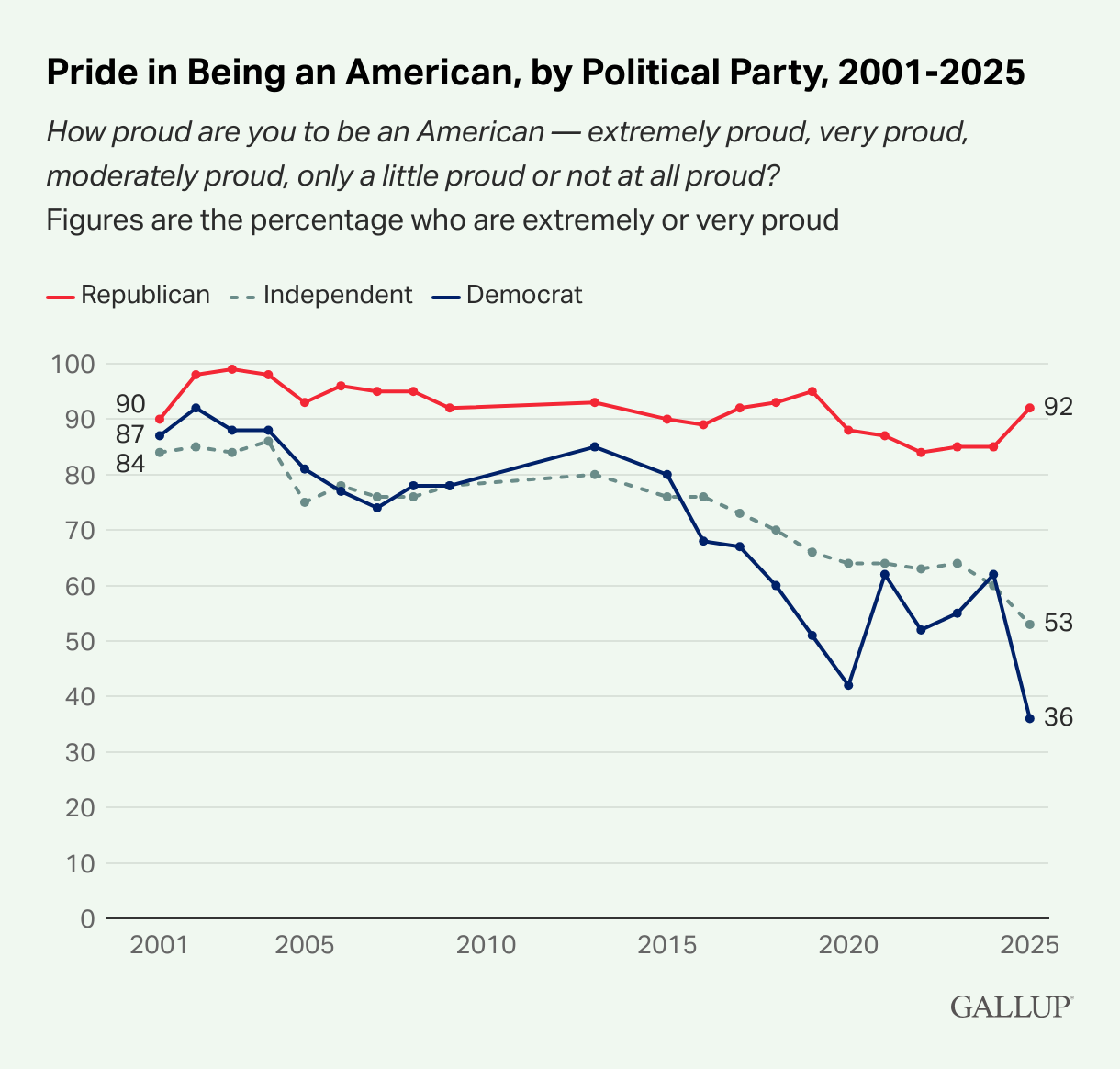
Many of us grew up at a time when being proud to be an American was no longer a given, but an attitude that tracked closely with political affiliation. While Republicans are about as patriotic as they were a quarter century ago, half of Democrats dropped their patriotism over the same time. The result is that much of the symbolism around the American national identity, including the American flag itself, are increasingly seen as symbols of right-wing affiliation.
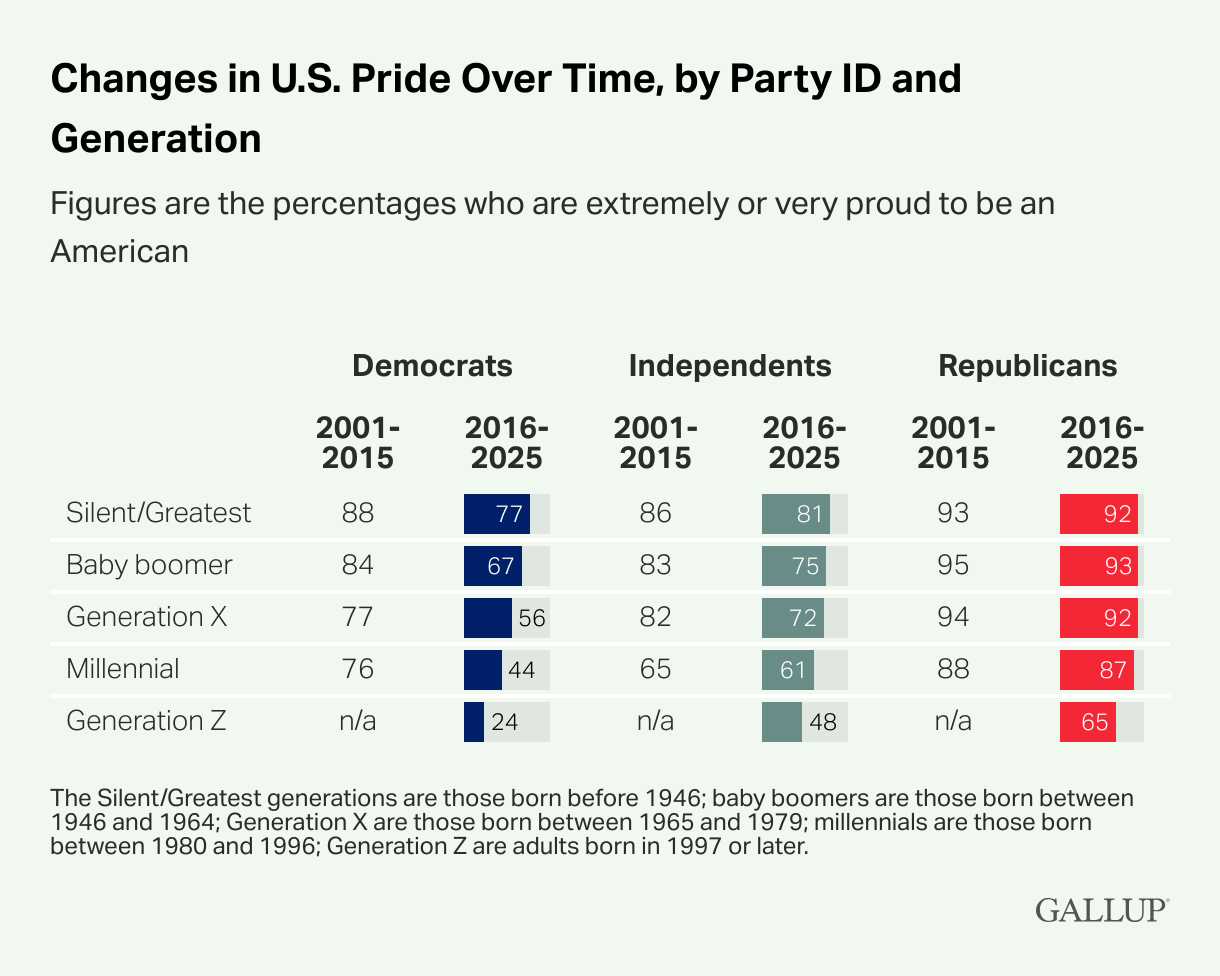
The collapse of American patriotism is also sharpest among the young. According to the same polling, every generation has shown less patriotism than the one that came before it, regardless of party affiliation. The effect is that American patriotism is far more associated with the old than with the young.
All this is notable because trans people in the US are, on average, both younger and more politically left-of-center than the average American. According to the Williams Institute, 42.7% of out trans people are between the ages of 13 to 24, more than twice the number of the US population in general (18.6%). In other words, over 2 in 5 trans people were under 14 when Trump was first elected, and likely have little memory of what politics was like before Trump's brand of politics became the norm in this country.
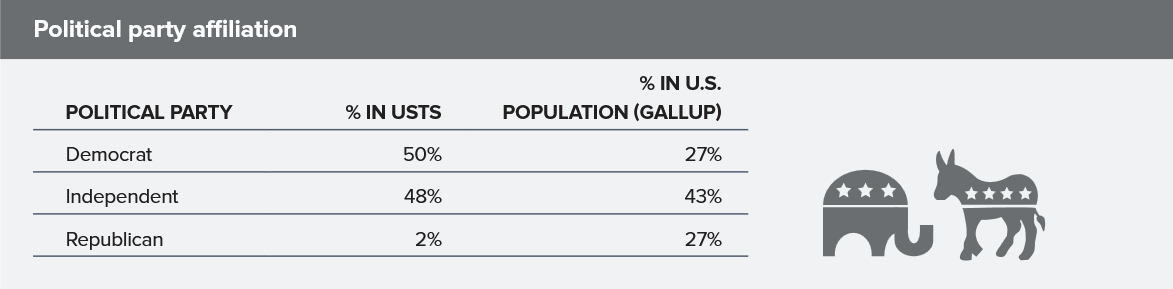
As for political affiliation, the 2015 US Trans Survey showed that only 2% of trans people in the US are affiliated with the Republican Party, as compared to 27% of the general population. Trans people have an extreme hostility to the Republican Party, more so than almost any other group.
The average trans person in the US is a leftist in their late 20s. This average profile shares little in common with that of the average American. We disproportionately fall into two demographics that are becoming less patriotic over time.
And all this was happening before we take into account the years-long campaign to remove us from public life.
This campaign is closely associated with the rhetoric of American patriotism, since most of the people who oppose our rights are themselves patriotic Americans. When federal agencies strip us of rights and dignity, they do it in the name of making America great again. When they say that this is what America wants, many of us take them at their word.
Knowing all this, it should not be surprising that so many trans people are at the very least alienated by open displays of American patriotism. To most of us, it is associated with the people and politics making our lives worse.
Why then would we be attracted by the creed of service before politics and country before self? Our country has told us that we ourselves have to subordinate our needs as trans people to that of the country at large. If our politics will not be taken seriously, why should we make sacrifices to serve the country? If we have no reason to make sacrifices for the country, then why would we be patriotic at all? What is the point of serving a country that treats us with contempt?
Beltway Mindset
While the young and left-of-center are growing skeptical of patriotism, one region where this change has been slower is in the Beltway, the area around Washington D.C.. This is the center of US political power, hosting agencies like the CIA where Curlee worked.
The city has traditionally been a hub of both patriotism and left-of-center politics. While administrations came and went, there was no shortage of jobs for progressive-minded people looking to serve their country. Until the massive cuts to federal jobs last year, it was a place where patriotism and progressivism were seen as complementing one another.
This is the environment in which Curlee served for nearly 20 years. It is also an area with a disproportionately high trans population. Despite this, it is an environment alien to many trans people.
I am in a peculiar position in this regard. I hold little sympathy for trans people serving in an administration that is actively making my life worse. At the same time, I used to live in the Beltway, and intimately know many people who are currently in the same position that Curlee was in. If things had gone differently for me, I might have joined them, and ended up in the same situation as Curlee.
I can relate to her because much of my formative years were very similar to hers. Like her, I was raised by Jewish immigrant families who came to the US, assimilated, and believed that patriotism was important to social advancement. Like her, I earned a Master's Degree in a subfield of Political Science. Like her, I lived in the Beltway while my career was first taking root.
At this time I had a girlfriend who, like Curlee, struggled to balance serving the public with the personal discrimination she faced as a trans woman. Nonetheless, she and many of my friends (most of them trans as well) encouraged me to apply for government jobs that looked for the skill set I was learning in school. My then-girlfriend assured me that as a Political Science student with experience living abroad, I would be perfect for the State Department.
None of those ever worked out, but if things had gone differently, I might've been kicked out of public work for being trans, just like Julia Curlee and many others.
I was never particularly patriotic in the way that she is, but I also grew up in a less patriotic time and place. However, if I had gotten the jobs that people told me I was perfect for, that might have changed over time. The Beltway has a way of instilling in public officials the notion that they are working for a cause bigger than themselves. Across the political spectrum, these people are taught to put service before politics and country before self.
If that means serving under, for example, a Vice President who displays open contempt for people like you, then that would be an acceptable price, because in that world view, the mission comes first. I cannot say for sure that I would never have taken up that creed. Like everyone else, I am not immune to propaganda.
The Future of Trans Patriotism?
Julia Curlee is hardly an outlier in this sense. She only happens to be an outlier for holding to that creed while being trans. As previously mentioned, many trans people do not share this call to patriotic service, and are (at best) confused by those trans people that do. Given the trend away from patriotism and the years-long campaign against trans dignity, this indifference to selfless public service is not likely to change anytime soon.
There aren't many new people like Julia Curlee entering public service, in no small part because we often aren't allowed to work there anymore. Those trans people coming after her will struggle to understand why she and so many others did what they did, because she is a product of a time and place that is very different to our own. She is not a fool; she is a product of a bygone era.
The Needle was unable to reach Julia Curlee for comment.